Friday, July 19, 2019

Words Matter!


Mike Anderson WHAT WE SAY AND HOW WE SAY IT MATTER—Teacher Talk That Improves Student Learning and Behavior

Words Matter! A lot! Especially with students. We know when students walk through our doors, our most important priorities for us as educators are to make them feel safe and valued. Mike Anderson is the author of What We Say And How We Say It Matter: Teacher Talk That Improves Student Learning and Behavior. In his book, he captures the “Why” the language we use sends a message to our students that may or may not have clear intentions. Anderson stated, “...specifically, this is a look about the intersection of our positive intentions and our language habits--and working to better align the two” (p. 4).


Anderson shares critical insights for educators to become even more mindful of engaging students in their learning process with careful consideration of the language we use. “Students must assume more power and control of their learning, cocreating rich learning experiences with their teachers. And when it comes to discipline, being obedient rule-followers is no longer enough. Students need to learn to think and act in ethical and responsible ways, so they are ready to be independent and deep thinkers, not simply compliant workers” (p. 5). 

Being more mindful of the words we use and the messages they can convey can empower all of us.  Here are a few of my favorite take-aways from Anderson’s book that I plan on sharing with staff this year. It should be a great on-going conversation to allow us to continue to prioritize why the words we use with our students matter.


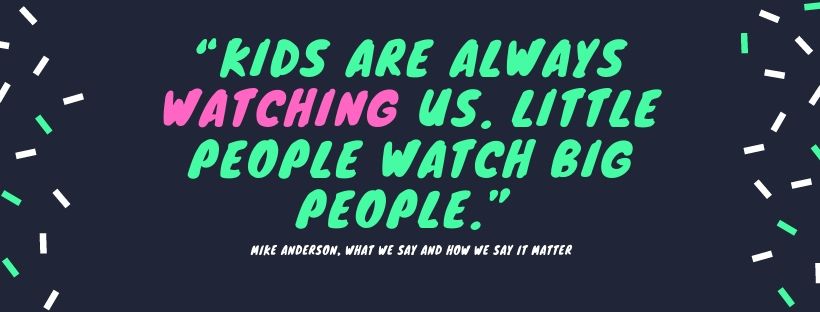
Big Idea: You are always modeling.


Bid Idea: Humor is funny. Sarcasm is hurtful.

Big Idea: Yep, we all make mistakes. Own it.


Big Idea: Take the “you” out and make it about them.


Big Idea: Learning should be meaningful and engaging for each of our learners.

Big Idea: Don’t ever, and I mean ever say, ”After ___ we will do something fun.”

Big Idea: Practice doesn’t mean perfect, but it does allow you to get better.


Big Idea: Let students talk more!

Big Idea: Small bites of formative coaching before, during and after learning.

Big Idea: The words you use matter for our students. Be more mindful of how you
use them. 


Monday, July 8, 2019

Our School Story

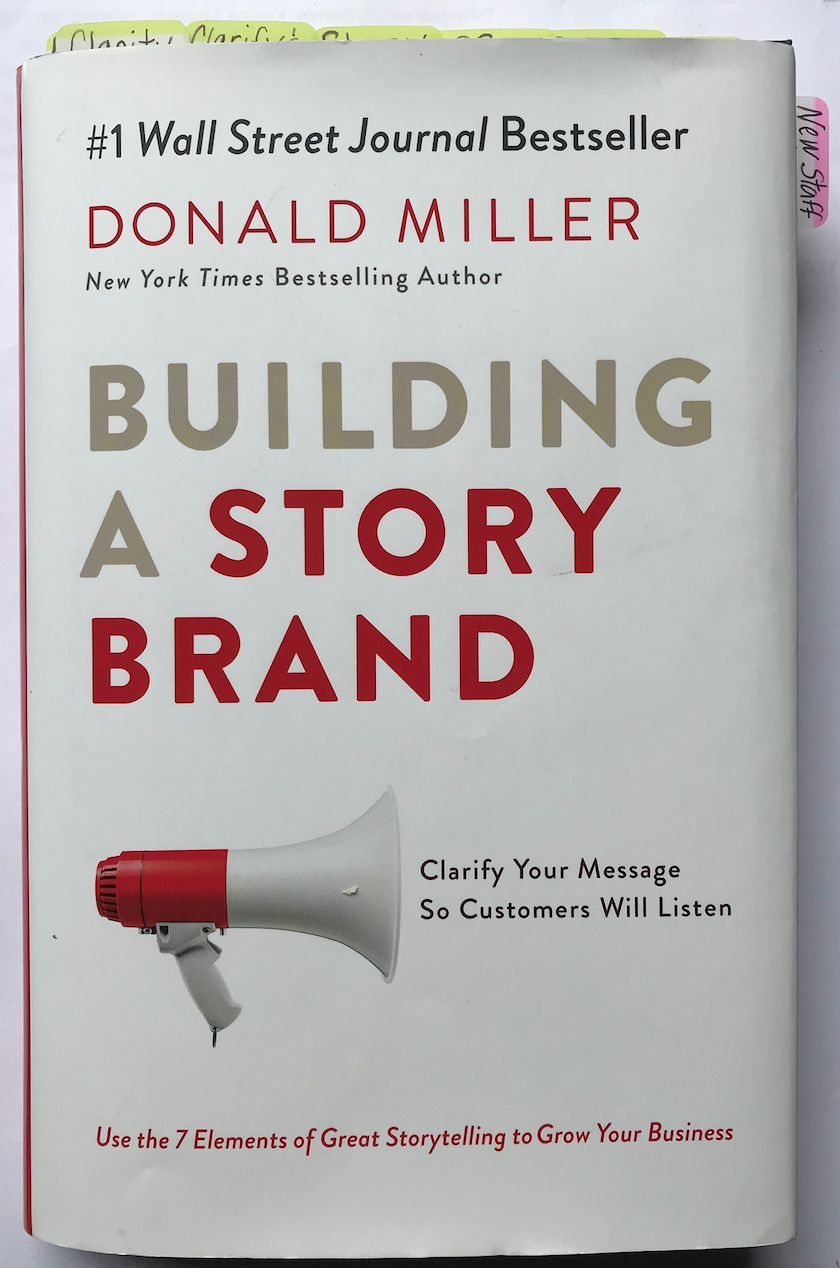
Donald Miller BUILDING A STORY BRAND—Clarify Your Message So Customers Will Listen

The topic of branding appears to be a popular conversation in media these days. As an example, in NPR’s Hidden Brain July 1st, 2019 podcast Shankar Vedantam interviews Americus Reed who is a marketing professor at the University of Pennsylvania. Their lively and often humorous banter around branding included discussing how some perceive the use of branding as “a force for good” and others as “manipulative” and even “inauthentic”. Their quick back and forth dialog on branding included an analogy of a hammer which can be used to build a home for those in need or used as a weapon to inflict harm. The point is the hammer is not a bad tool, but it is how you use it that matters. Reed declared, “Why not use it (branding) as a force for change, as something powerful and positive?”

Which brings me to Donald Miller’s book Building A Story Brand: Clarify Your Message So Customers Will Listen. During our school improvement journey for the past five years, we have been relentless on changing our school’s story as we facilitate positive growth towards equitable outcomes for each of our students. Although I am not sure this was Miller’s intent to use his latest book to support a school’s perspective on reframing their school story, having clarity on the “why” of our actions has been a critical story element on our school improvement initiative.


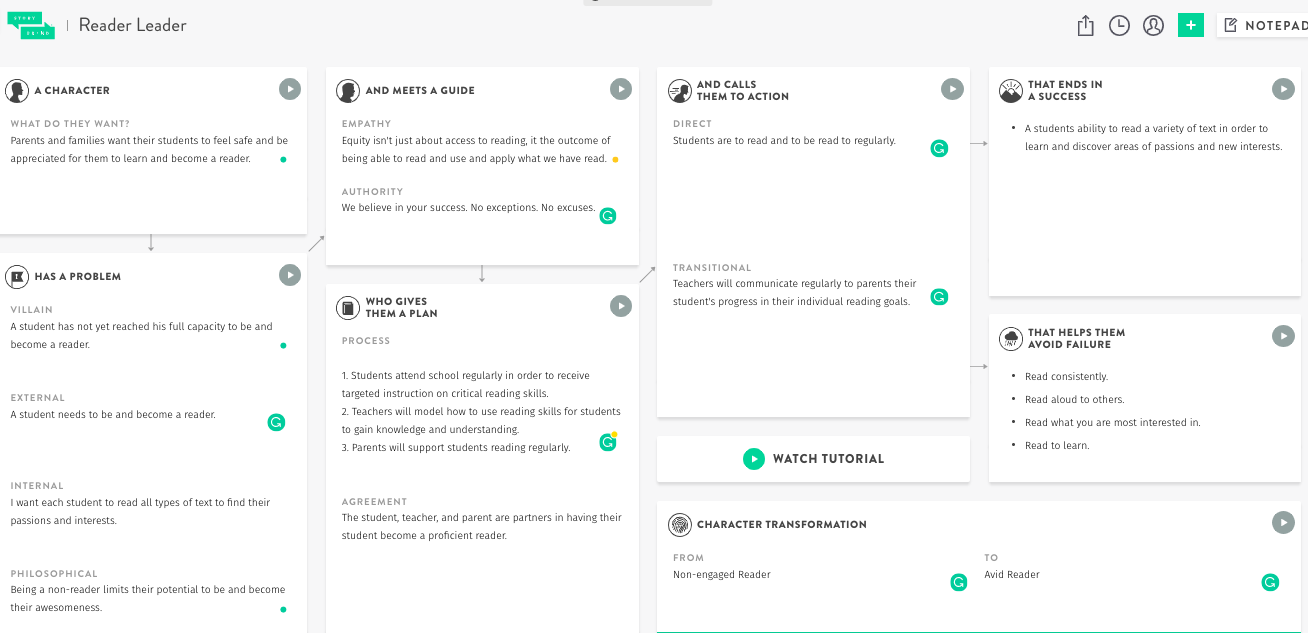
What I so appreciated in Miller’s book was just how simple the journey can be to build your own storybrand starting with clarity. Eliminating the “noise” and focusing on what the hero in your story wants, who or what is stopping the hero from getting what they want, and what will life look like when they do or do not get what they want. In our case, the hero will and will always be our students. We want to support them now and as they transition into their next steps. Miller gives the reader a seven-step storybrand framework and provides an online template to create an individual brandscript as a guide to “simplify your marketing and messaging”. The chapters go into depth on each step in the storybrand framework and use popular world figures and familiar characters in movies to emphasize key components as you create and customizing your own brandscript.

Selfishly the number one priority I have set for each of our students is to become a reader. Not just picking up a piece of text because their teacher or parent told them to do so, but because they are compelled to do so. I want reading for them to be something they do because it is who they are and how they interact with the world around them. And most importantly because it is joyful. Yes, joyful. It’s a door to an unanswered question, a window to a possibility, and a trail toward discovery. I also believe it’s a civil right owed to each child. I used reading as a focal point for our school’s brandscript. It’s a rough draft, but certainly worth refining with our leadership team.


Miller states when building a storybrand you “invite their customers into a story that makes their lives better” in order for the world to become a better place. I know as we purposeful build our storybrand we want our heroes to continue their path to be and become the reader leaders we know they can be. Our ultimate end goal is to build empowerment now and in their futures so they can be well-prepared self-directed learners.

Thursday, June 27, 2019

Choose Courage over Comfort


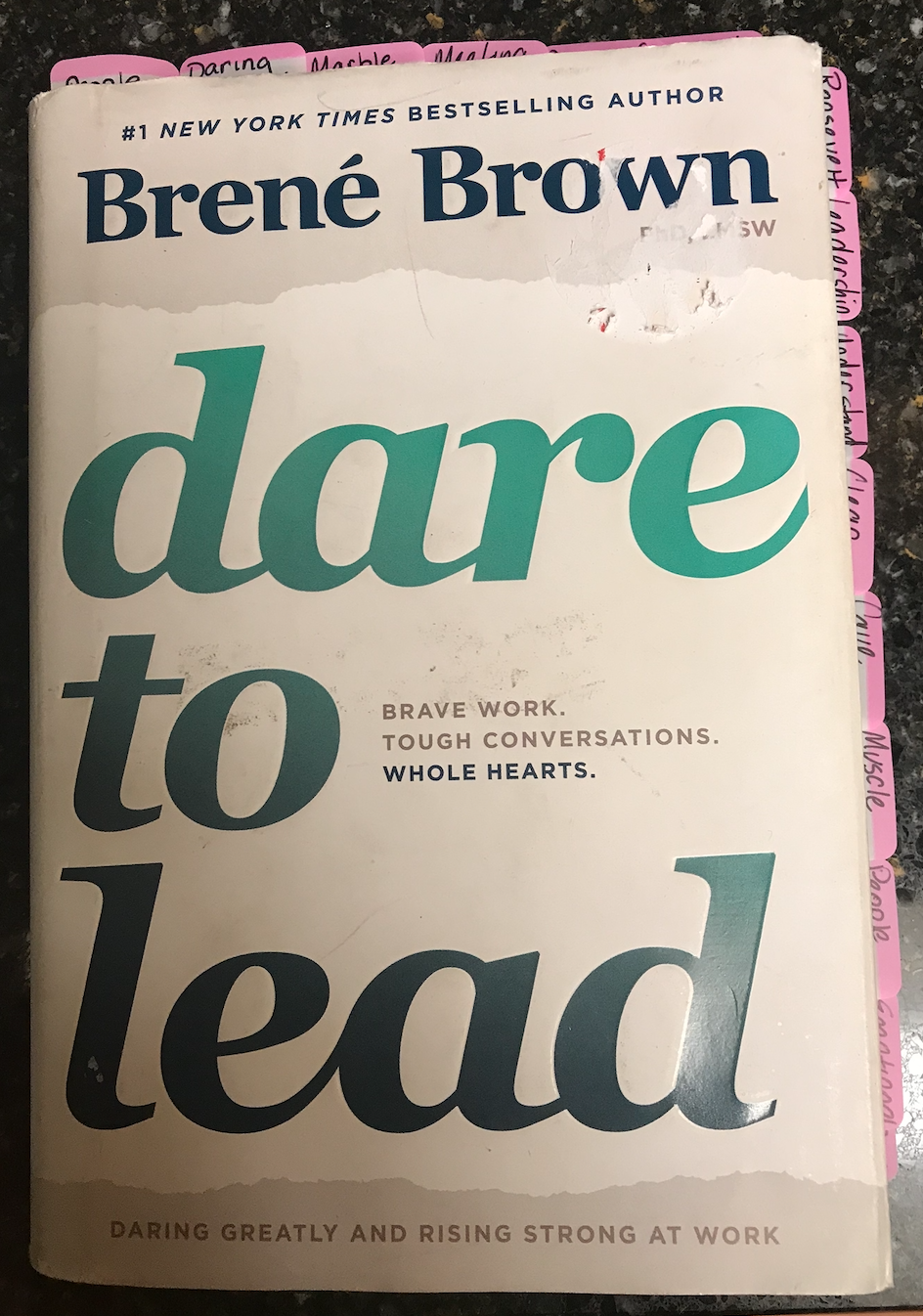
BrenĂ© Brown dare to lead—Brave Work. Tough Conversations. Whole Hearts.

I just finished my eighth year as an elementary school principal. I've truly loved every minute of my time with staff and those who support our drive to teach and inspire students to be and become their awesomeness. What I have learned is creating a positive school culture takes a lot of hard work, belief mindset, and most importantly, a shared leadership framework. I strive to be the type of leader that empowers teachers to be their best teacher leader self for each of our students. I also continue to push myself to be a more thoughtful and purposeful leader who is always a learner in order to serve well.


When Brené Brown's newest book, Dare to Lead: Brave Work. Tough Conversations. Whole Hearts. was published, I knew I needed to read it. Maybe it is my competitive spirit, but honestly, the word dare jumped out of me, and I know I still have a lot to learn when it comes to leadership. One area of focus for me is facilitating those difficult conversations for others to reach their greatness and have more of an impact on students achieving their "yet" goals. I know I need to fine tune this leadership skill, but daring myself to be better gives me a jumpstart.

I read and listened to Dare to Lead on audio while traveling back and forth to attend a principal conference...every minute counts to a busy leader! One of the featured speakers was principal Beth Houf, who is an inspiring middle school principal, author, and motivational speaker. Houf authentically and warmly encourages her audience to be that leader who creates a school culture where students and staff want to be a part of while learning and performing at high levels. She mentioned she is a quote junky, and for whatever reason, that is how I read and interpreted Brown's book Dare to Lead. There were so many gems of wisdom I wanted to capture them for my own learning.

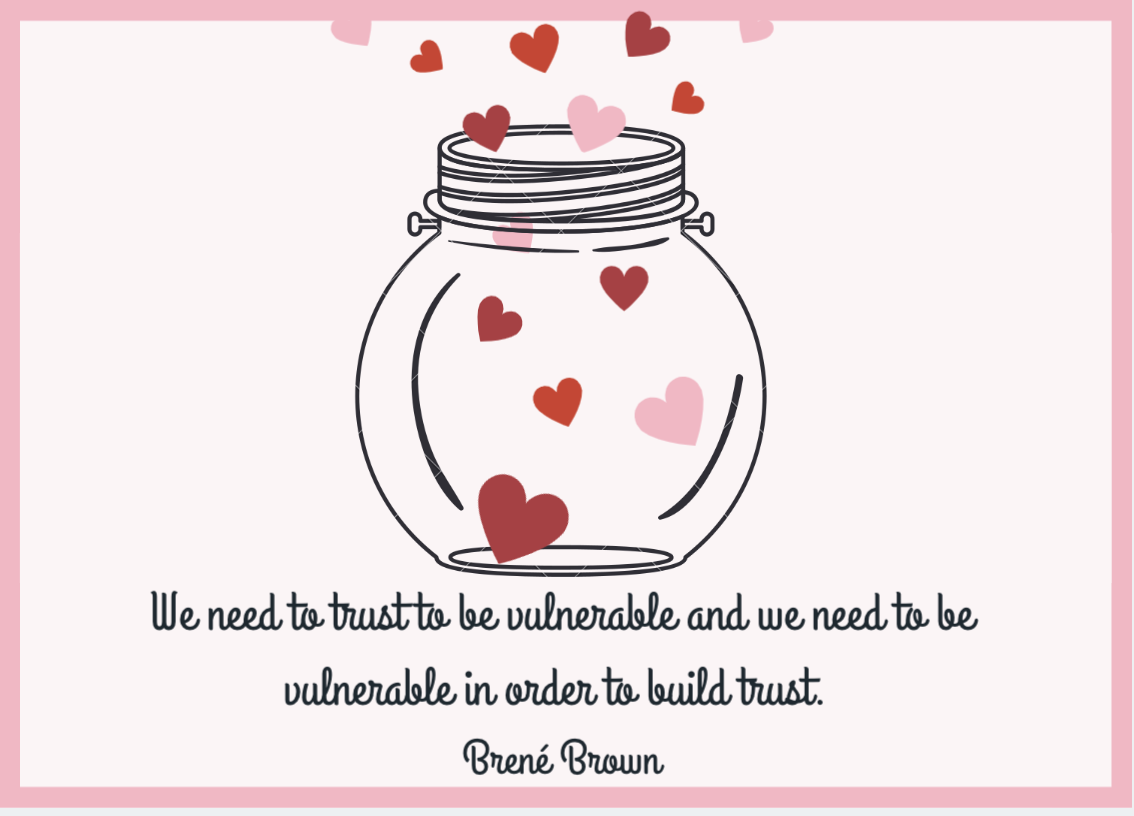
Brown begins her first section with defining vulnerability "as the emotion we experience during times of uncertainty, risk, and emotional exposure" and used a metaphor of filling or depleting a marble jar to emphasize the relationship of trust and vulnerability. "Trust is the stacking and layering of small moments (adding marbles) and reciprocal vulnerability over time. Trust and vulnerability grow together, and to betray one (depleting marbles) is to destroy both." Brown also shares, "We need to trust to be vulnerable, and we need to be vulnerable in order to build trust." A leader who dares to lead understands the importance of honesty, even during hard conversations and embraces doing so in a safe environment where we seek to learn more not for sympathy but understanding. This is vulnerability and trust in action.


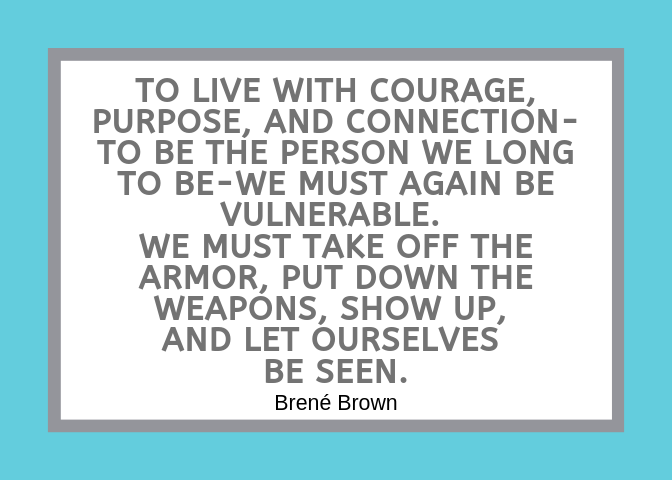
These conversations often require principals like myself to dismantle our armor of vulnerability "and talk about hard things and tackle tough subjects" with courage. Brown referenced Joseph Campbell's famous quote, "The cave you fear to enter holds the treasure you seek." Critical conversations can be extremely uncomfortable but often allows you and those you support to find the treasures you seek. Thinking about our school community, the treasures we seek is to find ways to empower each of our students to progress, achieve, and exceed their goals. Strategically analyzing the data together, having important conversations, and finding inequities of subgroups is an opportunity for teachers and leaders to move forward and lead with less armor and more daring strategies.

Here is the poster I want to put on my wall right across from my desk...at eye level.  


Brown then gives a list of 16 examples of Armored Leadership behaviors posted side by side with Daring Leadership practices to consider, followed by a comprehensive summary of each one.  Brilliant, because as a school leader I am wondering if too often I am "hustling for our (my) worth" (Armored Leadership) rather than "knowing our (my) value" (Daring Leadership). In addition, am I guilty of "collecting gold stars" (Armored Leadership), versus "giving gold stars" (Daring Leadership)? I should consider posting the list too!

There are so many other gems in Brown's latest book Dare to Lead, but the last takeaway I'll share is found in section two, "Daring leaders who live into their values are never silent about hard things" including for me leaning into "living my values" when giving feedback to teachers. What I love about Brené feedback recommendations is they lean into my core value of being of service to others. Each feedback guideline Brown recommends has the mindset of collaboration rather than in isolation including; sit down next to you, in front of us, listen and ask questions, acknowledge what you do well, recognize strengths, accountability without shame and blame, owning my part, thank someone for their efforts, lead to growth, and modeling vulnerability and openness.

My "why" is to lead by empowering our teachers to become purposeful instructional leaders. This requires a sense of bravery as a leader who is willing to build trust with careful steps towards vulnerability adhering to values that allows us to rise together rather than alone.

Sunday, April 14, 2019

You Are Enough


Kristin Van Marter Souers with Pete Hall RELATIONSHIP, RESPONSIBILITY, AND REGULATION —Trauma-Invested Practices for Fostering Resilient Learners


I wanted to read just one book over spring break. With a brief reprieve requiring flights to and from home, I needed something that would refill my cup and put the pieces of my thinking into place. Being a principal often requires you to constantly be on the go with quick yet thoughtful responses to questions and concerns in your back pocket. I am a big fan of Kristin Souers and Peter Hall’s first book Fostering Resilient Learners. Their second book Relationship, Responsibility, and Regulation Trauma-Invested Practices for Fostering Resilient Learners was an obvious choice for me after I read the first paragraph of their Preface. The author’s stated “Whenever I train and consult, I want attendees to walk away saying, ‘Now that was a good use of my time!’ When you’re finished with the last paragraph in the last chapter of this book, I hope you say the same thing.”

Rather than write a summary of Souers and Hall’s book I want to share my reflections as a leader who is constantly on the search for practices that will ultimately enhance the learning experience for students and staff. In their second book, they reviewed the five fundamental truths about what is known about trauma. In brief summary, trauma is real for each of us and it is more prevalent than we think. Not only is trauma literally toxic to the brain and its development, but in our schools and classrooms, we need to be aware of its impact in order to support our students so they can be and become the “competent, special, and awesome” individuals we know they can be (p. 1-3).

Souers and Hall remind the reader that our mindset matters. Do we hop on the bandwagon and become a trauma-informed school, which is certainly a phrase we hear a lot in education right now, or do we dive deeper and become-trauma invested school? Meaning...creating a learning environment where students not only learn they thrive! (p. 21-27). I want our students to go to that type of school, where they not only know, they believe they are capable learners and strive to get closer to their “yet” every single day. So where to start?
The authors recommend teachers and leaders understanding student needs versus student behavior. This was the biggest ah-ha reminder for me because well there are days that is all I do...behavior management. Souers and Halls reminded this reader, “Every behavior is an expression of need.” And they said it over and over...understandably to help make it stick. Our next course of action is “need-sleuthing”. What are the “needs underlying their actions” and “break the behavior down by need” including their emotional, relational, physical, and control needs? The author’s recommendations including being relentless in your inquiry on “What need is this child trying to make?” (p. 53-55).
It is important to note this is not a solo journey but one you take together in partnership with the student, the staff and their families. Rather than admiring the challenges students bring to school, you rally as a team with a forward-thinking mindset to find a student-focused solution that works. Remembering, the student is a critical member of the problem-solving team with the adults in the room and together you determine an outcome and the steps needed to support student’s ownership of their actions. Key for growth is these actions are in partnership with the student rather than for or to the student.
The first step begins with relationship strategies that are meaningful for the students. Souers and Hall offer the reader plenty of recommended relationship strategies for educators to incorporate with their daily interactions with all students but are truly beneficial for students impacted by trauma. A few simple suggestions include using the child’s name often, ask questions, and most importantly listen. Students have a wealth of knowledge inside their trauma-influenced brains with a story to tell. It is up to us to remember to stop talking, lean in, and listen to decipher how we best support the student.
My favorite takeaway is the “whisper-wish” relationship strategy. Consider a student or a group of students and begin their day by whispering, “Ooh, I have a wish for you today: I wish you [or each of you] will ____.” Just think of the possibilities>  You can wish them to remember to be kind to themselves or others, find a new favorite book, make a different friend today, and the possibilities go on and on. Finally at the end of the day, after the seed of the expectation has been planted you revisit it by simply asking, “Did my wish for you come true today?” It gives them a goal, a purpose, and a belief statement all in one simple wish (p. 85).
We then move onto to teaching them the responsibility needed to internalize how their actions affect themselves and those around them. These students are often burdened with multiple narratives that regularly summon self-doubt and negative belief system. Souers and Hall refer to the story of The Little Engine That Could. We need to be their champions who remind them of their competence “I knew you could. I knew you could.” Moving away from their fixed mindset towards growth with frequent invites for them to keep trying. Responsibility strategies include providing clear expectation, setting goals with frequent check-ins, assign responsibilities or jobs in their classrooms, and the lifelong skill of grit and determination. They may not have reached their goal yet, but that doesn’t mean it is not attainable.
Finally, it is so important to teach them how to regulate and manage their emotional state including moving away from their fight and flight “downstairs brain” to understanding the cause and effect connections in their “upstairs brain.” Students needing support with regulation can be easy to see. They fidget often, find transitions difficult, shut down, or shout out, and can do all of the above up and down all day. Regulation strategies give students tools to manage their “emotional and behavioral responses accordingly (p. 151). We are just beginning some of these regulation strategies in our school and have already found the benefits of starting our day with soft music, an expandable stress ball to regulate their breathing and lots of brain breaks with movement throughout our day.

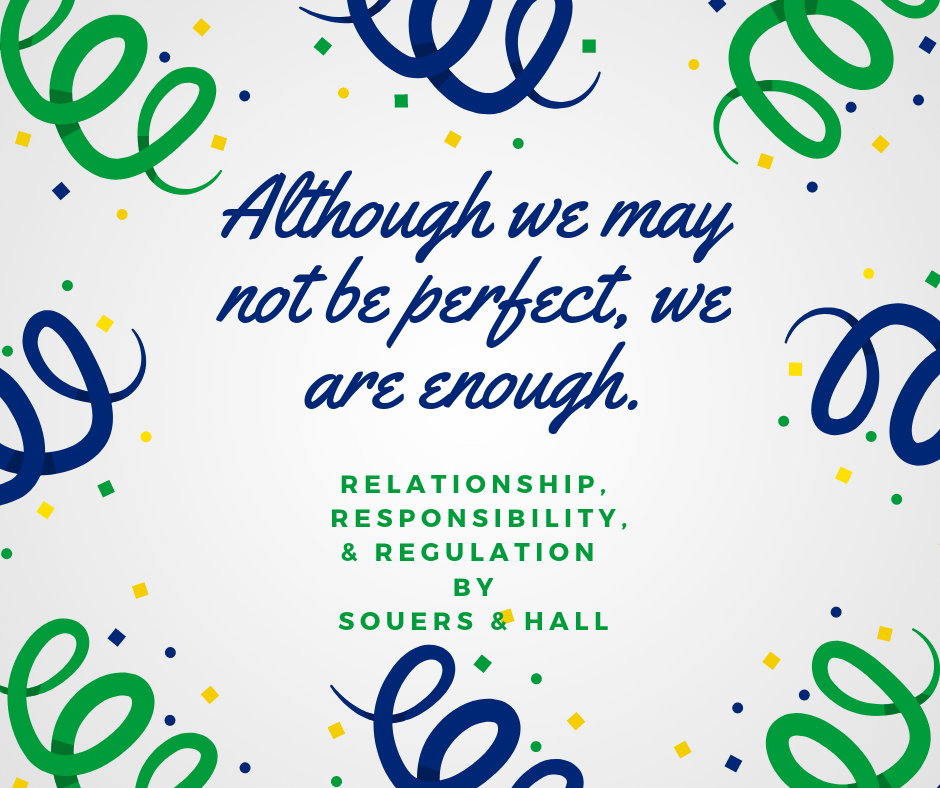
Although Souers and Hall remind each of us none of the relationships, responsibility, and regulation strategies will be effective if we don’t first take care of ourselves first. There is a list of these self-care strategies in the book and the recent blog post of their Fostering Resilient Learners website. A few of my favorites was to literally breath, share “the work” with others, sleep, show your gratitude and remember…“Although we may not be perfect, we are enough” (p. 194). We can get stuck on how difficult the multitude of challenges we face in our roles as we support students, but it requires maintaining an “Eeyore-Pooh balance”. Don’t let you negative pessimistic side outweigh your optimistic side, and vice-versus (p. 191).


“All our students need us to focus on their strengths and potential. They look to us to provide assurance that we see them as having potential in a safe, predictable, and consistent manner.”
Kristin Souers with Pete Hall

Sunday, March 10, 2019

Our Calling as Learners Who Teach/Lead

Brad Gustafson RECLAIMING OUR CALLING —Hold on to the HEART, MIND, and HOPE OF EDUCATION

I learned about a group of educators who would be reading Reclaiming Our Calling by Brad Gustafson on Twitter. The author and an invited guest would facilitate an online conversation about the book through a Facebook Live event first immediately followed by a Twitter Chat. Both discussions were to be held in the evening for about an hour. Online participants could join these interactive conversations in both social media platforms or the one that worked best for them. The author and invited guest would start the conversation with key insights from the assigned chapters and participants could then jump in with comments on Facebooks or Tweets on Twitter. I was totally intrigued by the process.
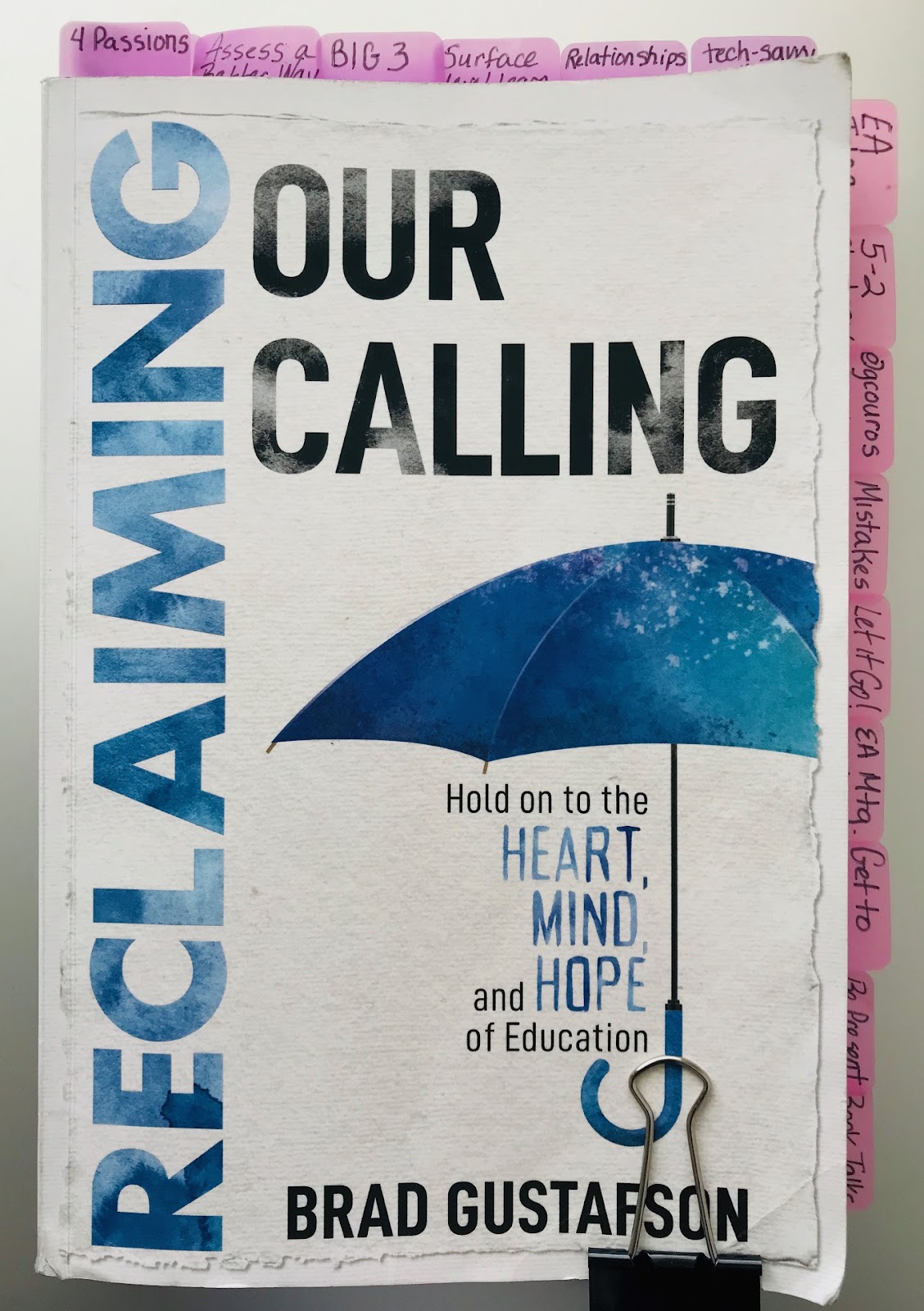
As building principal who often lives in isolation when it comes to professional learning I was all in to try a new approach. This is the second book for Gustafson, and I was already familiar with his drive and relentless focus to create positive and meaningful experiences for students and staff. In this book, Gustafson shares four passions on how educators can “Hold on to the Heart, Mind, and Hope of Education” and how to adhere to our “Moral Foundations” of teaching and learning by “Reclaiming Our Calling” and keeping students at the center of our work.

The weekly online conversation centered around how to enhance and prioritize relevant learning experiences for our students and staff during the Facebook Live event, as well as the Twitter Chat. The professional learning for me came when I was able to listen and learn from educators all across the country as we shared out takeaways from assigned chapters. I was reminded of proven practices, gained new insights, and was constantly reminded what we choose to do in our role as educators matters a lot to our students as well as the staff we willingly serve. Here are a few of my favorite takeaways from the four passions.

Gustafson reminds the reader “The Core of Our Calling” is “Learning that Lasts” (p. 40). To make learning “stick” for our students we’ve got to understand what is important to them as learners. To do this we must be more intentional with the discussions we have our students. “The conversation is the work.”...The important work of building relationships is done through conversation. It’s accomplished by being present and creating a place for students to be curious” (p. 62). Message for me...get into classrooms more often, sit down with students, discover their hopes, passions, and interests and make those incredibly important connections. By discovering what is relevant or important to them, I can then help them navigate where they can contribute and gain momentum to their own learning in order to make school not something they do, but experience.


Conversations with staff matter too AND being truly present when you are having them. Gustafson writes about educators who write personal reminders to themselves by writing “5-2” on their to-do lists. “The numbers represent the goal of having at least five meaningful conversations with individual staff members and writing two personal thank you notes each day. When we remind ourselves of what is real and write down what we want to stand firm on, we’re more likely to follow through. I’d like to challenge myself to do this with staff but morph it a bit and challenge myself to have five conversations with students each day as well, and write down two things I’ve learned in my school picture photo album. Not necessarily just to connect, but discover their dreams and interest. “When we start with relationships and practice acts of intentionally, we honor the whole leaner…” (p. 61).


I must admit my day as a principal can be extremely long and I am guilty of going into autopilot in order to accomplish the prioritized tasks I set out to do each day. Gustafson offered several strategies to “short-circuit” our autopilot mode. “It may sound simple, but the first strategy to short-circuiting your autopilot mode is to do something different each day to disrupt your routine” (p. 146). He recommended making small changes first before implementing change on the grand scale including being “more intentional about connecting with different students” (p. 147) and I’ll add staff. Which is why I am hopeful my morphed 5-2 strategy doesn’t just become an item on a checklist, but an opportunity to connect with our students and staff.

Although in order to do so I’ll need to be mindful of Gustafson’s strategy of being fully present to avoid autopilot mode. “Make it a habit to be mindful of where you are and whom you’re with” (p. 162). Including for me to physically stop moving, texting, speed walking, etc. and to get down to where students are at, look into their smile and lean in and listen. “The very best educators are able to see the perspectives of others while being able to navigate the system to meet the needs of their students. And the best way to understand somebody else's perspective to be fully present when you’re in the same spaces” (p. 160). Admittedly hard for me to do!

There are many more important “Passions of the Profession” in Gustafson’s book I highly recommend for teachers and administrators to revisit and consider, but my favorite really is found in his “Donut Theorem” (p. 178). He relates the crust of a donut to the (teaching and leading) traits we have, to do the work we love. The crust is incredibly important, but not near as wonderful as the jelly. “Your jelly represents your passions, curiosity, and strengths” (p. 179). My jelly continues to become a leader who provides avenues for teachers to become champions and implementors of effective instructional literacy practices in their classrooms at every opportunity. Every child deserves the right to be and become a reader in whatever avenue works for them as a learner.


It’s not often I carry around the same book with me for weeks at a time, reading a passage again, marking the text further, and making plans. At the end of our book study, a question was asked by Gustafson, “What are you going to do with the book?” Other than committing to making the changes I’ve shared in this post, I’ve purchased the book for a colleague I respect and admire tremendously and selfishly so I can lean in and learn, in order to continue to reclaim my calling as a learner who leads.

Saturday, January 26, 2019

What If...


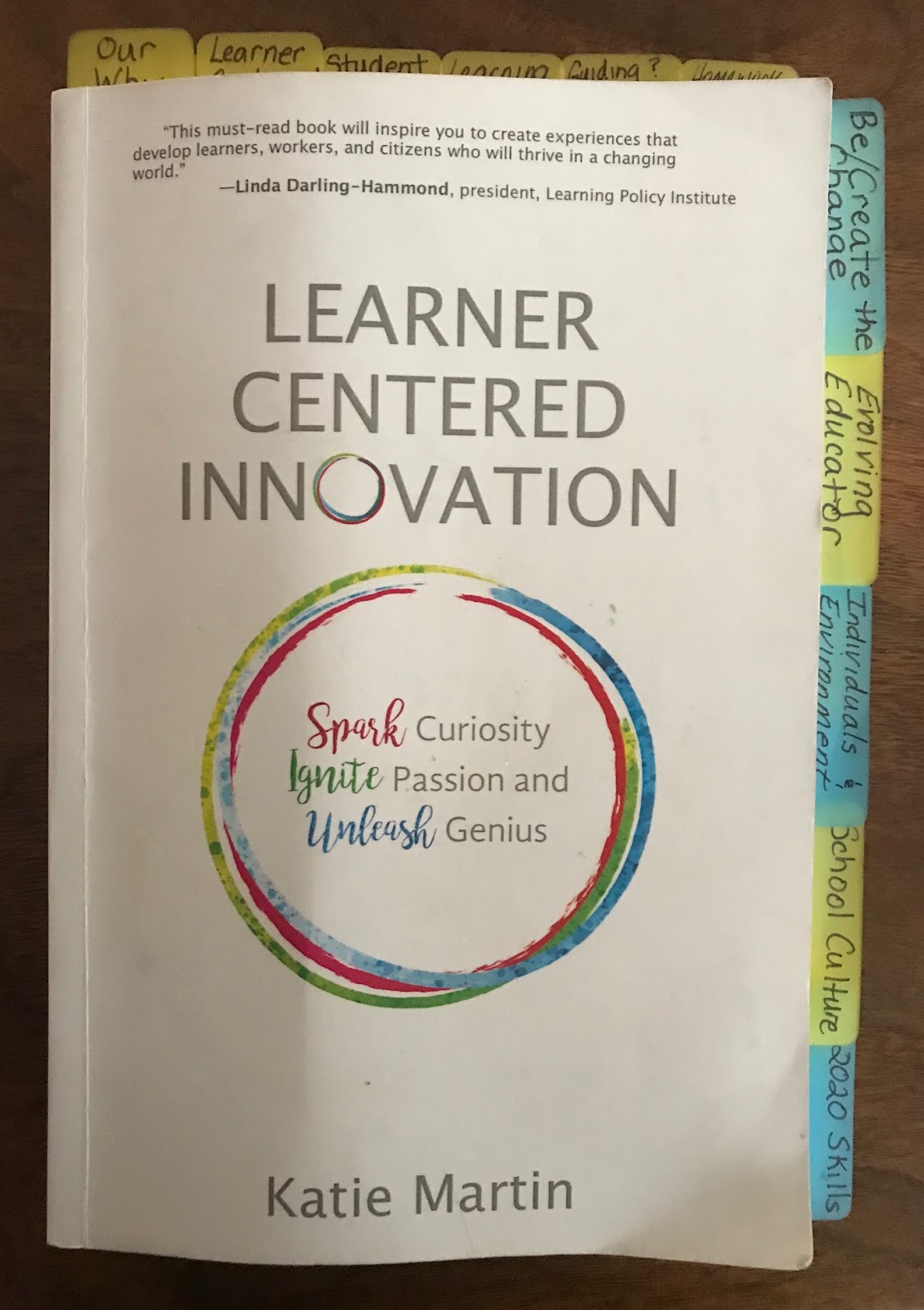
Katie Martin LEARNER CENTERED INNOVATION—Spark Curiosity, Ignite Passion
and Unleash Genius


I am just pages away from finishing Katie Martin’s book Learner Center Innovation, Spark Curiosity, Ignite Passion, and Unleash Genius and I’ve reached yet another section in the book that is leaving me incredibly inspired as a leader to well...do better.  The preface in Martin’s book encourages the reader to “Be the Change” and start to reframe what learning looks like in our schools and classrooms by asking the question, “What if?”
Although Martin also encourages the reader to remember, “The role of you, the reader, is not to just consume and copy my ideas or the ideas of other I will share, but to dive in, question, create new meaning and ultimately ask ‘What if?’ and begin to create the change that you wish to see in your context” (p. 14-15).
There was a multitude of innovating ideas I came away with to do and be a better leader. The one idea that is keeping me up at night…in a good way was found in Chapter 10, “Better Together.” Martin shares a personal experience when she joined a Professional Learning Community (PLC). The team was moving through the motions of answering the essential questions of a PLC and diligently completing the form and minutes in order to turn in their completed task. Her experience sounded too familiar and caused me to genuinely reflect on what I have been asking teachers to do regularly.
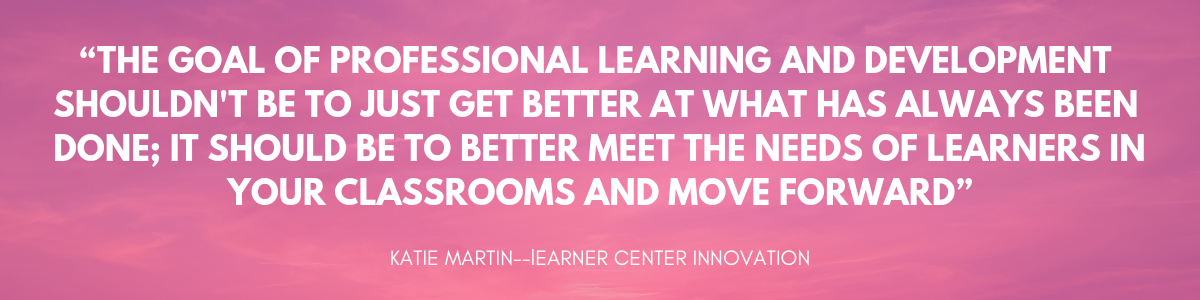
Then my “ah-ha” occurred when I read the next sentence. “How much more useful could that meeting have been had the focus been on using their questions to delve into ways to improve their practice?” The essential questions of a PLC are nothing less than brilliant in my opinion, but Martin reframed innovation for all of us by stating, “The questions they asked are great if they are used to guide and investigate practices and to collaboratively explore new and better ways to meet the learners’ needs.” Moving the PLC process from“compliance-based cycles to cycles of learning that empower teachers to improve their practice and meet the needs of the learner.”
“Imagine the same cycle, but (what if)…
  • Instead of focusing on the right answers, teachers have the opportunity to experience new models of learning and shift their thinking about what is possible in the classrooms.
  • Based on new experiences, teachers work together to select goals and research what works in their classrooms with their learners.
  • They determine the best evidence to gather and analyze based on their goals.
  • Teachers collectively provide and receive peer feedback and support to improve based on the shared vision, their goals, and the needs of their learners.
  • This kind of cycle ensures that the vision and goals for learners remain the driving force for professional learning” (p. 260). 

Martin gives the reader critical items to seriously consider during a cycle of inquiry. “Trust is imperative to empowerment, but it should not be confused with abandonment” (p. 268). This cycle of inquiry requires balancing the structure of a learning cycle (in my case the essential questions of a PLC within the framework of the data team process), and the collective inquiry of professional learning of our teams. Building collective efficacy not only prioritizes the professional relationships we develop and the diverse experiences we each bring to the conversation in order to  “create the right kind of culture, which requires prioritizing time and experiences that help us grow” (p. 271).

The cycle of inquiry is just one of Martin’s recommendations to “spark curiosity, ignite passion, and unleash genius.” Martin's book also includes multiple ideas for not necessarily doing more but being more purposeful and framing “the why” we need to keep our learners at the center of innovation.

Sunday, January 6, 2019

A Must-Read for Each School Leader

Jeanne Spiller & Karen Power LEADING with INTENTION—8 Areas for Reflection and Planning in Your PLC at Work


As a school leader, I am continuously on a path to refine and improve my leadership skills to facilitate learning for both our amazing students and staff. Spiller and Power, authors of Leading with Intention have generated a tremendously practical resource for school leaders to use while “reflecting and planning our work” to enhance learning. In each of their eight chapters, they have culminated an area of practice found in the PLC process as defined by DuFour and Eaker as, “An ongoing process in which educators work collaboratively in recurring cycles of collective inquiry and action research to achieve better results for the students they serve.”

I found two ways a school leader could read Spiller and Power’s book Leading with Intention. You can read each chapter in succession to reflect on the leadership practices that are needed and which leadership practices to avoid to facilitate learning. The chapters can also be read individually as the reader prioritizes the leadership steps needed to refine their school’s PLC systems. I also thought of it as an excellent reference tool to continue to go back to as we progress in “achieving better results for the students we serve."

Chapters topics include strategies on how to achieve focus and stay intentional. Honestly, this is hard to do when there is just so much to do. ”The struggle is real.” The authors also discussed the “systems and protocols” needed to “establish and maintain organization” including, “practices that focus on trust, respect, and belonging.” The saying goes, it’s not what you do, but how you do it. These chapters speak of this truth.

Confession, Karen Power is a colleague and I could continue to hear her voice loud and clear when reading the chapters on shared leadership and using evidence for decision making and action. These two chapters I continued to re-read to glean a greater understanding on how to “build the team”, create “shared leadership among staff members”, and “guiding the team” in “taking collective responsibility for student learning.” Personally, this has been the greatest reward for me as a building leader...to see teachers take ownership of student learning by prioritizing the essential questions of a PLC embedded in the data team process. These chapters helped me refine my leadership skills.

Another chapter discussed the importance of prioritizing each student. Each being the keyword followed by a chapter on leading instruction for improvement.  I came into this role as a building principal because I wanted all teachers to lead in their classrooms with the knowledge needed to be instructional leaders. The authors guide the reader on how to “focus on instruction in a PLC” in a “positive classroom environment” through collaborative inquiry considering “an equitable learning environment” which includes “equal access to learning for all students in a school."

Finally, the last two chapters remind you of the value of "fostering communication" and "developing community and relationships". “Strong communication skills are a key feature of powerful leadership” which includes developing “productive listening habits” to develop “deep understanding” in order to have the “crucial conversations” needed when “stakes are high..opinions vary..and emotions are strong.” Communication is often referenced in many leadership books, but the authors clarify the communications skills needed for school leaders in order to have meaningful conversations on student learning. Putting “the why before the what” “people are more likely to understand the work and commit to it.” Whew! This is the hard part and it takes a commitment from a leader to level up one’s leadership “in the spirit of whatever it takes.”

At the end of each chapter, I used the reproducible tool provided for the reader to record their “current reality and next steps.” Key components of each chapter list a reminder of what great leaders do and what great leaders avoid. Writing my reflections as I read provided a perfect opportunity to record my thinking and plan my next steps to drive the change for our school improvement plan. Here are a few of my insights.