Sunday, August 5, 2018

Student Choice

Mike Anderson LEARNING TO CHOOSE CHOOSING TO LEARN — The Key to Student Motivation & Achievement

I picked up Mike Anderson’s book Learning to Choose, Choosing to Learn: The Key to Student Motivation & Achievement because I needed to refine an instructional routine that has become ineffective for our learners. Creating a perfectly aligned blocked schedule for core content is a painstaking endeavor and one that can be posted for all to adhere to its unwavering time frames. What was missing in this traditional schedule was allocated time for students to have more choices in their learning and create meaningful projects that allow them to demonstrate and apply their new skills and understandings. For clarity purposes, this doesn’t mean student choice cannot occur during core content time, but I needed to understand the concept of choice at a higher level and to allocated more time during the instructional day for student choice to occur more often.  

Anderson just completed a blog post reviewing the three conditions needed to set up student choice including considering the learning environment, student ownership, and teaching our students how to learn. I highly recommend reading his blog post as a general overview on how to utilizing students choice as a pathway to motivating students to be owners of their own learning and even better reading the Learning to Choose, Choosing to Learn book in its entirety. In addition to these foundational conditions for student choice, my takeaway from Anderson’s book included an important reminder on the power language has when setting up opportunities for student choice. “Language is a primary vehicle for setting the tone of the room. If a teacher’s language is kind, sincere, supportive, and professional students feel safe. They also take their cue about how to treat others by how teachers talk to them” (p.36). I would add this applies to school leaders too.

The subtle use of the language teachers, support staff, and principals use makes an enormous impact on our students. Throughout Learning to Choose, Choosing to Learn Anderson reminders the reader exactly how we can change the use of our language to support more opportunities for students to make their own choices. Here are some of his examples I am adding to my list of refined instructional practices to help me continue to motivate our learners and empower their achievement.

Discipline Practices & Setting the Tone: (p. 37)
Avoid: Look at how well Marcus is cleaning up!
Try: Remember everyone should be cleaning up
Suggestions for Shifting Voice & Rethinking Praise: (p. 49)
Avoid: I’d love to see some great effort on this project.”
Try: “Some great effort will help your work really shine in this next project.”
Suggestions for Positive Feedback: (p. 50)
Avoid: “I love the way you are working as a team.”
Try: “You’re really working together as a team.”
Suggestions for Constructive Feedback: (p. 51)
Avoid: “I’m so disappointed in you. You could have done much better.”
Try: “I know you’re upset. Let’s think together about what you can do to improve this?
Suggested Language for Students as Learners: (p.70)
Avoid: This poem is amazing! You are such a talented writer.”
Try: “This poem has such depth of feeling with so few words! Tell me about how you wrote this?”
Suggestions for Guiding Students Thinking: (p. 101)
Avoid: “If you really want a challenge, this one is for you.”
Try: “Think about the level of challenge that is the best fit for you.”


School is starting in exactly four weeks from tomorrow. The start of the school year is such a critical time to return to building positive relationships with our students. I look forward to changing my words and my mindset and to model to our learners the power choice can have on their learning with additional allocated time in the instructional day for this to occur.


Wednesday, July 25, 2018

The Science and Secrets of Timing

Daniel H. Pink WHEN—The Scientific Secrets of Perfect Timing

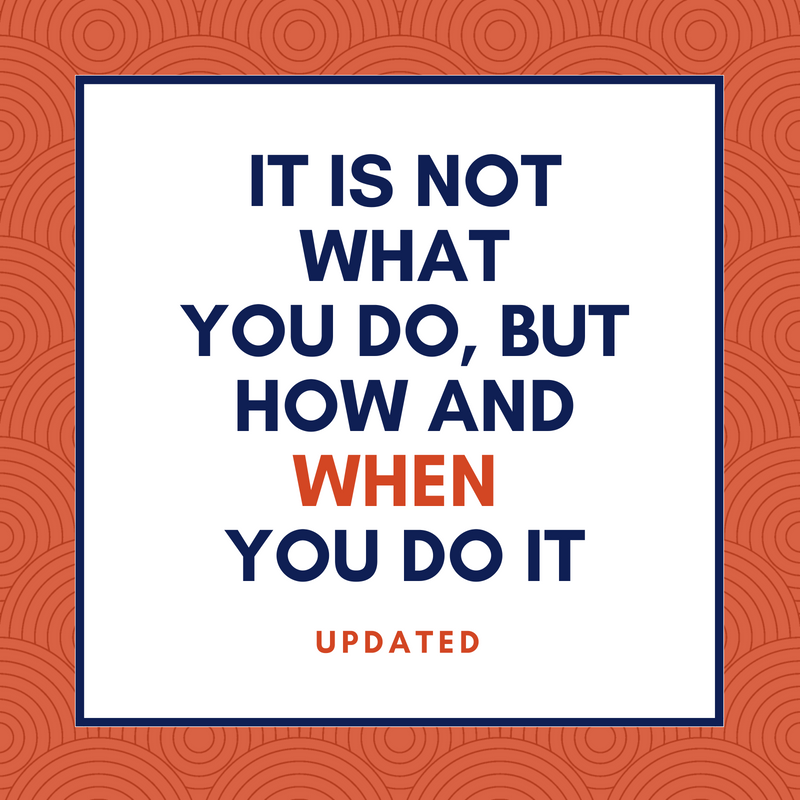
I am not sure who to give credit for this quote, but I have heard it several times over the course of my career in education.

After reading Daniel Pink’s book WHEN The Scientific Secrets of Perfect Timing I would change it up to...

Pink has culminated “an emerging body of multifaceted, multidisciplinary research that offers fresh insights into the human condition and useful guidance on working smarter and living better” (p. 4). This is not a how-to book, but rather a “when-to” book. The type of task you do, and at what time you do it...matters. Pink begins with identifying the “peak, trough, and rebound patterns of one’s day and guides the reader to determine if they are a “lark, third bird, or an owl” (p. 28). The reader can then create their very own “daily WHEN chart” (p. 40) to decide when to best complete an analytical task for optimal peak performance or when the brain needs time to mull over a problem in order to gain “insight” and experience those ah-ha moments. Pink guides the reader to understand our “cognitive abilities do not remain static over the course of the day...they change.” These “daily fluctuations are more extreme than we realize” and “the best time of day to perform a particular task depends on the nature of that task” (p. 22).

My three major reflections from Pink’s book WHEN.
My first ah-ha occurred WHEN I discovered what “ultimately matters” in completing important work--timing. I identified my type (alias a lark) and categorized my peaks, troughs, and rebounds of a typical workday. Knowing this I can then prioritize and synch the optimal peak time(s) of my day with essential tasks where I need to think and act clearly rather than mindlessly completing mundane chores needing less focus.
The second important takeaway is WHEN I take a break which admittedly is never. I know, I know breaks matter...even for a few minutes. I need to get up, get moving, and get outside with a colleague and detach from conversations around work. Recently on a Voxer group chat, a participant indicated they actually schedule their breaks on their work calendar. Brillant!
Finally, my third lasting impression headed towards the group which Pink also shared “must be synchronized...to the boss, to the tribe, and to the heart” (p. 181). “Working in harmony with others, science shows, makes it more likely we’ll do good” (p.199). As an educator, I would add with our students at the heart of all that we do, prioritizing my timing would inspire me to go beyond just  “good” and do and be better.

Pink closes his book with these thoughts, “I use to believe that timing was everything. Now I believe that everything is timing (p. 218). I would add, how we choose to use our time and use it well, is up to us.

Sunday, July 8, 2018

Responsiveness

Anthony Kim & Alexis Gonzales-Black THE new SCHOOL RULES—6 Vital Practices for Thriving and Responsive Schools


As an elementary principal facilitating a turnaround school improvement initiative I am continuing to learn what critical components are needed to reform a school. When a colleague sent me The new School Rules—6 Vital Practices for Thriving and Responsive Schools by Anthony Kim & Alexis Gonzales-Black, the word thriving jumped out at me. In the midst of all of our school improvement reform efforts above all else, I want our students and staff to truly blossom and thrive.

Our foundation for school improvement started with building meaningful relationships with our students, each other, families, and our partnerships in the community. With these connections as the groundwork, we continue to focus on our school culture by nurturing a positive learning community where struggles are embraced, celebrated and utilized as the next jumping off point towards growth and change in our teaching and learning practices.

I have also learned none of the above would be as successful without the implementation of school-wide systems in order to do this work. The authors Kim & Gonzales-Black shared the need to pay more attention to the management and work practices found in the field of education. They stated,

and 

The key word—being responsiveness. This responsiveness includes schools that are continuing to evolve to what is happening in the present, have a clear inspiring purpose, and always, always aiming higher to improve. Author’s Kim and Gonzales-Black provide an organizational framework that identifies fundamental practices for planning, teaming, managing, decision-making, sharing information, and defining a learning organization.

There are many relevant and practical takeaways for a school to demonstrate more responsiveness in their book, but for this reader, there were two favorites. The first included aiming for “safe enough to try” rather than simply relying on consensus. A key component of decision-making is trust that empowers staff who are doing the work to take action and make small, purposeful decisions. There will be times when the results will not go as planned, but by showing responsiveness to what they have learned along the way in order for them to “fail forward” to “refine and hone their ideas” to “make decisions smarter and faster for students.”

My second takeaway follows the above and supports the learning culture we have meticulously continue to prioritize and includes sharing what we have learned with others. This act of transparency also embraces being opened to the inquiries of others and responding with “Thank you for asking.” Kim and Gonzales-Black shared,

 so


Saturday, June 9, 2018

"Cultivating a Community of Learners...to become more than you ever thought possible."

Jimmy Casas CULTURIZE—Every Student. Every Day. Whatever It Takes.


I’m looking back to our school year. With just a few short days left, I can’t help but smile on the school culture we have all been relentlessly focused on as we continue our school improvement journey towards...yet. If I look closely, I can tell the staff is incredibly tired, but you have to know them to see this. They are still smiling, full of energy, cheering their students on to students' end-of-year goals. They are finishing strong and modeling for our students to do the same.

It was just four years ago we started the implementation of a school improvement turnaround model. The first step we prioritized was changing our school culture. Such an incredibly simple statement that turned out to be extremely difficult, endlessly rewarding, and never done. I picked up Jimmy Casas's book Culturized to help me figure out what we were missing, forgetting, or just overlooking. As it turns out, and as you can see from my notes...plenty.

Rather than write a recap of the entire book Culturize, here are just a few of my own personal takeaways that I want to use for reflection and share with our dedicated teachers and leadership team. You can find all of my reflections from Culturize on my Twitter feed @afewthingsworth. These insights and thoughts push my thinking forward to be and do better for our students, staff, and families.

I realize it would be easier to accept what is and just walk through our established routines and procedures. Maybe I would even be able to sleep at night, but I can’t. I just can’t.  I heard the author and speaker John Maxwell speak on being average, and this stuck with me. “To excel’ literally means to go beyond average.” In Chapter one, Casas's words added to Maxwell’s thinking, “We cannot allow average to become our standard. For our students to grow, and do, and be the amazing individuals we love, we are pushing ourselves to go beyond average.


When I read this passage in Chapter two, I felt like I needed to hit the repeat button over and over again. Listen, LIsten, Listen. I would add to this, lean in, be present, and learn the intent. Oh, and one more...put down your phone, take it out of your pocket, out of your hand, out of sight and sound of notifications forever dinging. We all want to be heard, and students are no exceptions.

One of Casas's last takeaways for me was found in Chapter 5 and focused on “the relationships we build.” Indeed that is what teaching and learning are all about. Whether it be the relationships you have with the teacher’s support or the students your serve, it is the center of everything. Yes, everything.


Casas reminds the reader, “We must remain vigilant that our words and deeds positively add to our school culture rather than negate it” (p. 9). “Let us rather act with a sense of urgency to re-culturize our schools, acknowledge there is no room for the status quo” (p. 177).

Friday, December 29, 2017

School Systems for Improvement


Karin Chenoweth SCHOOLS that SUCCEED—How Educators Marshall the Power of Systems for Improvement

It’s another rainy day in Oregon and I continue to hear drops of water pelting at my window. I am lost in thought just after finishing the book School's that Succeed: How Educators Marshal the Power of Systems for Improvement. The rhythm of rain falling on the glass and the content of the book are not unfamiliar, but in combination have provided this reader time for much needed reflection.  As a principal of a school in improvement I know “the work” is never truly done, but determining our school’s next steps is always urgently compelling my thoughts forward.

I applaud the work of Karin Chenoweth. In her recent book she shares other leaders steps in their own school improvement journey. At times the work is isolating and to know what others have done that has ultimately changed their students (and staff) trajectory of learning is---well inspiring to this learner. I go back to one of my favorite quotes from UCLA’s head basketball coach John Wooden who said, “It isn’t what you do, but how you do it.” I firmly believe his thinking applies to all educators no matter their role.

What do unexpected schools do to provide equitable learning outcomes for all students no matter what they may or may not bring to start their own life’s story?

They…

·      Have teachers who unconditionally believe in students and will do all things conceivable to build a foundation for their student’s future.
·      Have leaders who continually create, monitor, and evaluate their school systems that provide a learning culture for their story to take place.
·      Have schools that prioritize relationships first as a foundation for all of the above.
·      Provide access to rigorous and relevant content developed collaboratively that is student driven and evidence-based.


The rain never truly stops for long periods of time in an Oregon winter. It’s a good thing. The beat continues to remind me of Chenoweth’s closing comments.