Tuesday, June 30, 2020

Questions to Consider

Warren Berger THE BOOK OF BEAUTIFUL QUESTIONS—The Powerful Questions That Will Help You DECIDE, CREATE, CONNECT, AND LEAD


I must admit The Book of Beautiful Questions written by author Warren Berger has been sitting on my to-read list for quite a while now. It was a gift from a thoughtful colleague but it never got to the top of my pile of books until I listen to Daniel Pink’s Pincast 3.09 on intellectual humility. In his message, Pink asked the listener “do you have a willingness to recognize what you think, what you believe might be wrong.” Admittedly...this is a difficult question for many of us to ask and more importantly to then reflect on.


As a school leader with multiple decisions to make I often ask myself and others many, many questions before heading in one direction, But are they the right questions to ask to get the full understanding of the changes we need/want to make? Warren states, “To improve our decision-making capabilities, we need to sharpen our critical thinking. And to do that we must arm ourselves with a set of critical questions--and be willing to consistently ask and thoughtfully consider the questions before rendering judgment” (p. 18). 


In The Book of Beautiful Questions, Warren focuses on questions for better decision-making, addresses questions for creativity and innovation, frames how questions can support us truly connecting with others, and gives the reader questions to consider to develop stronger leadership skills. I highly recommend that those that read the book do so with a pen and notebook in hand. As you read write down those questions that can be utilized with humility to learn more from others who you serve, support, and yes love.


The initial list I created while reading consisted of twenty questions. I thought I could challenge myself to ask these on a regular basis. Reality check...not truly feasible considering the amount. I narrowed down my list by highlighting one in each of Berger’s categories and then condensed the list even more with just three questions and added one bonus question that acts more like a directive for myself for a total of four questions to consistently use. I selected the following.


A question to ask myself more often for self-reflection. 
Am I looking to protect and defend or seek to understand?

A question to ask teachers to gain their perspective and insights. 
Can one response really give me their entire perspective? What else do I need to know?

A question to ask students who often just make me laugh with their honesty.
Am I giving students opportunities to answer open-ended questions to share their thinking? 

BONUS QUESTION
A question to put on my computer monitor in my office to get me up and out!
Am I taking the time to connect with students, staff, and families?

Warren hares, “The challenge of leading, in almost any area, is becoming more complex and demanding” (p.16). Leading in isolation should not be an option for any school or organization. “From an individual career standpoint, continued success will depend on having the ability to keep learning while updating and adapting what we already know. We must continually invest or reinvent the work we do every day. None of this is possible without constant questioning” (p.14). 


With humility, ask, listen, reflect, learn, and change, in order to grow.


Thursday, June 18, 2020

Only the Learner Learns

Zaretta Hammond CULTURALLY RESPONSIVE TEACHING & THE BRAIN —Promoting Authentic Engagement and Rigor Among Culturally and Linguistically Diverse Students

I’ve heard Zaretta Hammond speak at conferences, present at webinars, annotated her book Culturally Responsive Teaching & THE BRAIN two times as I methodically read and process each idea. I also listened to the power of her message as she read aloud her book through an audible app twice. Each time I came away with another nugget of evidence-informed research on how our “brains are wired for connection” relevant to our relentless pursuit of having each and every one of our students be independent learners as well as readers. 


Although my current reality is we are all in the middle of an unprecedented worldwide pandemic and I need to know what to do right now as a school leader to support learning in our virtual classrooms. How can we make learning equitable and accessible for each of our students now that they are no longer in school, but isolated with their families at home, in hotels, doubling up with relatives and other unknown settings? More importantly, with the limited amount of synchronous “screen” time we have with students during Distance Learning, how do we deepen their learning by including the cognitive aspects of learning as identified in Hammond’s book Culturally Responsive Teaching and the Brain?

Hammond gives us four practice areas for Culturally Responsive Teaching including awareness, learning partnerships, informational processing, and community building. All incredibly important, relevant, and valuable to build the confidence of each of our learners. Although in this unexpected time in our nation’s history, I feel an incredible sense of urgency to identify consistent evidence-based instructional strategies teachers can utilize collaboratively in the fall. More than likely schools across the country will still remain in some form of Distance Learning next year based on the health of the majority of the people living in their communities. Learning environments for our students could include limited seat time in the classroom, learning remotely from home, and/or a combination of both. No matter the format that is selected this uncharted experience will require plenty of relentless grace with a forward-thinking, we can do this mindset.

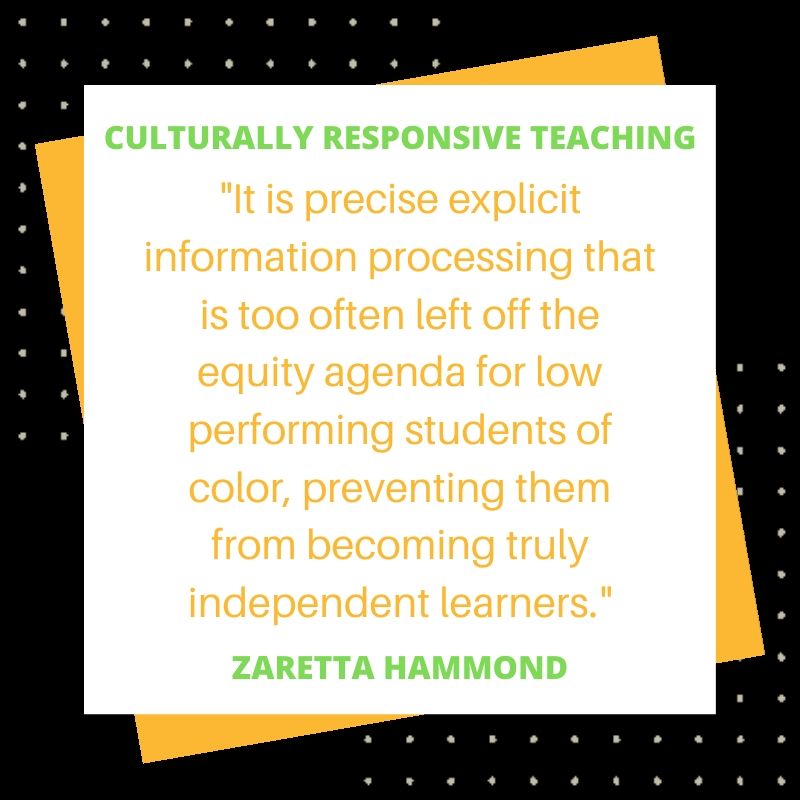
Hammon carefully reviews each of the three-stages recognized by cognitive sciences on how the brain processes information. She states, “The power of culturally responsive teaching to build underserved students’ intellective capacity rests in its focus on information processing...It is precisely explicit information processing that is too often left off the equity agenda for low performing students of color, preventing them from becoming truly independent learners” (p.124). 


She continues, ”As a culturally responsive teacher you should be planning instruction so that students move through the brain’s three stages of information processing--input, elaboration, and application” (p. 128). She implores teachers to consider these as essential components for every lesson, but should also include instructional strategies that help the student’s brain to not only process the information but to make it stick in their brain’s long term memory. The brief description of each stage and sample instructional strategies include:

    • Input - This stage helps students...focus on what you want their brains and minds to pay attention to. Here the information sits in the short term memory. “Think of this short term memory as a clipboard where you place temporary information” (p. 125).

      • Consider - a story, a poem, a quote, a puzzle, a problem, or a piece of music that will elicit emotion, a thought, or a question.

    • Elaboration - This stage helps students...make sense of what you just brought to their attention and to help them begin to better understand. “The brain moves the information from the clipboard of the short term memory on to the working memory”...“Think of the working memory as a workbench or tabletop” (p. 126). 

      • Consider - activities in a burst of short periods of time (5-20 min.) where students can practice, practice, practice what they learned. They are “kneading, massaging, and braiding together the material in order to make sense of it, and connect it to what the brain already knows” (p. 126).

    • Application - This stage helps students...apply what they have learned and to make it meaningful. Think of this as moving from the student’s tabletop to application with deliberate practice and real-life application.

      • Consider - “project-based learning or problem-based learning” opportunities not only for intentional practice now but “where it becomes part of our skillset, background knowledge, or conceptual understanding’ (p. 127).


As a culturally responsive teacher, Hammond offers “four macro-level instructional strategies that help students move through each stage” of learning” (p. 128-138). In my opinion, this is where the true joy of teaching and learning for both students and the teacher lives, grows, and thrives. It also has the ultimate potential to pass the baton of ownership of learning from the teacher to the student.

Ignite: Sparking the brain’s attention.
Chunk: Letting the brain take in bite-size pieces at a time.
Chew: Give the brain time to process and ponder.
Review: Give the brain a chance to apply what they now know.

Although in hearing Hammond speak it is critical to remember what Culturally Responsive Teaching is not. “Teachers need to interrogate their practice a little more robustly,” says Hammond. “It’s not an off the shelf program, it’s not two or three strategies. It is not plug and play.” To be more culturally responsive, consider gamifying with repetition, and connections. Consider it to be a social collaborative activity rather than a student sitting in isolation. Finally, storify it by creating a cohesive story that has relevance and meaning for the learner. (Cult of Pedagogy, Gonzalez & Hammon, Sept. 2017).

The question I continued to ask, Is any of this even possible during a pandemic without our students in our classrooms? In early May of 2020 Hammond address just this question on the Vrain Waves podcast. Using the analogy of the Apollo 13 space voyage. In this historic event, both the astronauts and those in the space command center had to puzzle through how to return to earth after a default of equipment during space flight. Working collaboratively they had to determine what resources the astronauts had on board the shuttle they could utilize in a different way in order to come home safely. The same applies to us as educators during a pandemic. Hammond suggests a resource to consider as we all navigate Distance Learning together is our parents and families. Converting our student’s homes into classrooms is not recommended, but we can develop a partnership with them on what learning should include for their students while at home.

What if…teachers and leaders prioritized relationships with parents? 

What if---teachers affirmed the parents are the teachers while at home?

What if...teachers and parents then co-planned lessons together? 

What if...teachers and parents become the co-collaborators of constructing learning activities with a happy medium of “the packet” with curiosity?


Hammond continues in the Vrain Waves podcast to remind the listener, learning pulls us all forward. She acknowledges the learning gaps that students are experiencing worldwide as we remain isolated. “Learning Gaps turn into Opportunity Gaps, that turn into Achievement Gaps.” Distance Learning is not the dragon” where the gold is right now is behind the challenge to get our students to be readers, be independent, and have curiosity. “Only the learner learns.” 


I am hopeful this unforeseen historical challenge will be a time for innovation and reinvention of what is possible. Hammond’s Culturally Responsive research and framework can act as our guide and a reminder of what the brain needs to learn and what impedes that growth. We are all in this together.

Friday, May 29, 2020

#WeGotThis


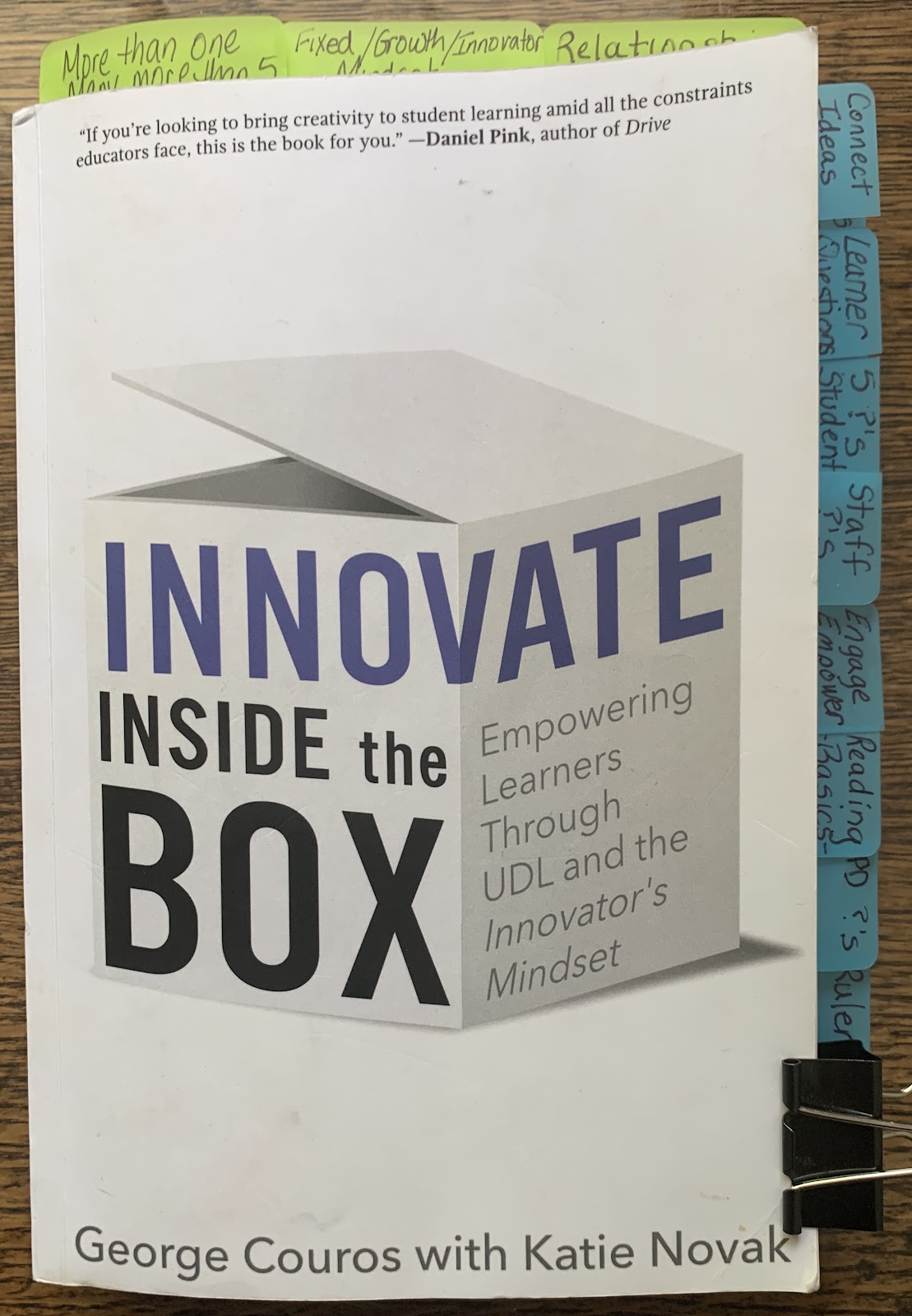
Geroge Couros with Katie Novak INNOVATE INSIDE the BOX—Empowering Learners Through UDL and the Innovator’s Mindset

Non-fiction has been my book of choice for as long as I can remember. On a rare occasion, when I read or listen to an audio story...I speed-read or fast-forward to the end of the book 99% of the time. I just get bored and want it to end. With the limited time I have to sit quietly and absorb the words in a text, I want it to be meaningful to me and to help me as an educator continue to learn and explore new ideas. George Couros and Katie Novak’s book Innovate Inside the Box did just that and pushed my thinking forward to being and becoming a better leader who still has a lot to learn.


The book has three parts. The first section focuses on the foundation of relationships, the learner, the master learner, and the learning experiences that have the greatest impact on all of us. The second section takes us back to the characteristics found in Couros’ first book The Innovator’s Mindset but adds the expertise of Novak’s experiences with Universal Design for Learning (UDL). Finally, the third section gives the reader a challenge to align with the “Change You Seek”. At the beginning and end of the book, the authors ask three questions. My hope is my personal reflections will propel another educator to read the book in order for even more of our students around the world to feel empowered on their own learning path.

Question One: What has challenged you?

I can’t get passed this one...yet. I am truly passionate about early literacy. Providing our students with the foundational skills needed for reading success now and as they transition into individual dreams and pursuits is what truly drives me. Teaching students to read and read well in order for them to make sense of their world in my opinion is a civil right each child deserves. As a leader in a turnaround school if I don’t make that a priority every single day more than once...my kids don’t move forward in a world that doesn’t wait for them to catch up. Where do these foundational skills fit into UDL?

Couros stated clearly early in the book, “Let me clarify something: Being an innovative school or teacher doesn’t mean you abandon the “basics,” it means you are focused on going much further than what only the basis could provide” (p.61). Yes! We are totally in alignment with this thinking. My challenge is creating a type of balance between the two, without accidentally creating a this then that mindset. Not insurmountable...but does tax the strength of one’s dendrites. 

Question Two: What has been reaffirmed?
Relationships are the core component of learning. Amen. Hand-clap. Head nod. Thank you to the authors for stating this over and over in a variety of valuable ways. These human connections are vital to educators in a world full of competitive distractions. These connections are not only what helps us understand our learners in order to engage them in the learning process...it’s a great way to “pass the baton” for them to take charge.

In my early literacy scenario, I am navigating Couros and Novak’s thoughts on moving from compliance (you are going to learn to read), towards their why or engagement (reading will help you learn), to ultimately (reading to connect or create something you value). The following example used in Innovate Inside the Box, helped me tremendously to clarify these connections.

“You will be better at speaking if you are good at listening.”
Your writing will probably benefit from reading the work of others” (p. 55).


Question three: What will you do moving forward?
Our district just adopted the UDL framework for lesson planning in order to reframe the learning experiences for each of our students. The teacher’s initial UDL training was rolled out just a few weeks into Distance Learning during the COVID19 pandemic. No commit..not my decision. And note to self...never do that again.

I know as the building lead learner I will be looked to for guidance, direction, and frankly mindset on how we move forward as a cohesive team for the students in our school. This is one of my greatest joys and biggest challenges. I continue to move two steps forward and one step back as a leader...but we are getting closer to our goals to have each of our students leave their elementary school years as not only a reader but a child who is excited about learning and also is developing the mindset their efforts really have an impact.

To move forward I want to make commitments to my teachers as lead learners in their classrooms, grade level teams, and our school community. I want to commit to providing “Multiple Means of Engagement” for all of us to take risks and fail forward both individually and as a collaborative team as we relentlessly pursue our path of equity by ensuring each student becomes a learner who reads and reads well for self-meaning. 

#WeGotThis #WeCanDoHardThings #ItsNotWhatYouDobutHowYouDoIt #TogetherWeSucceed


Sunday, May 17, 2020

Assumptions


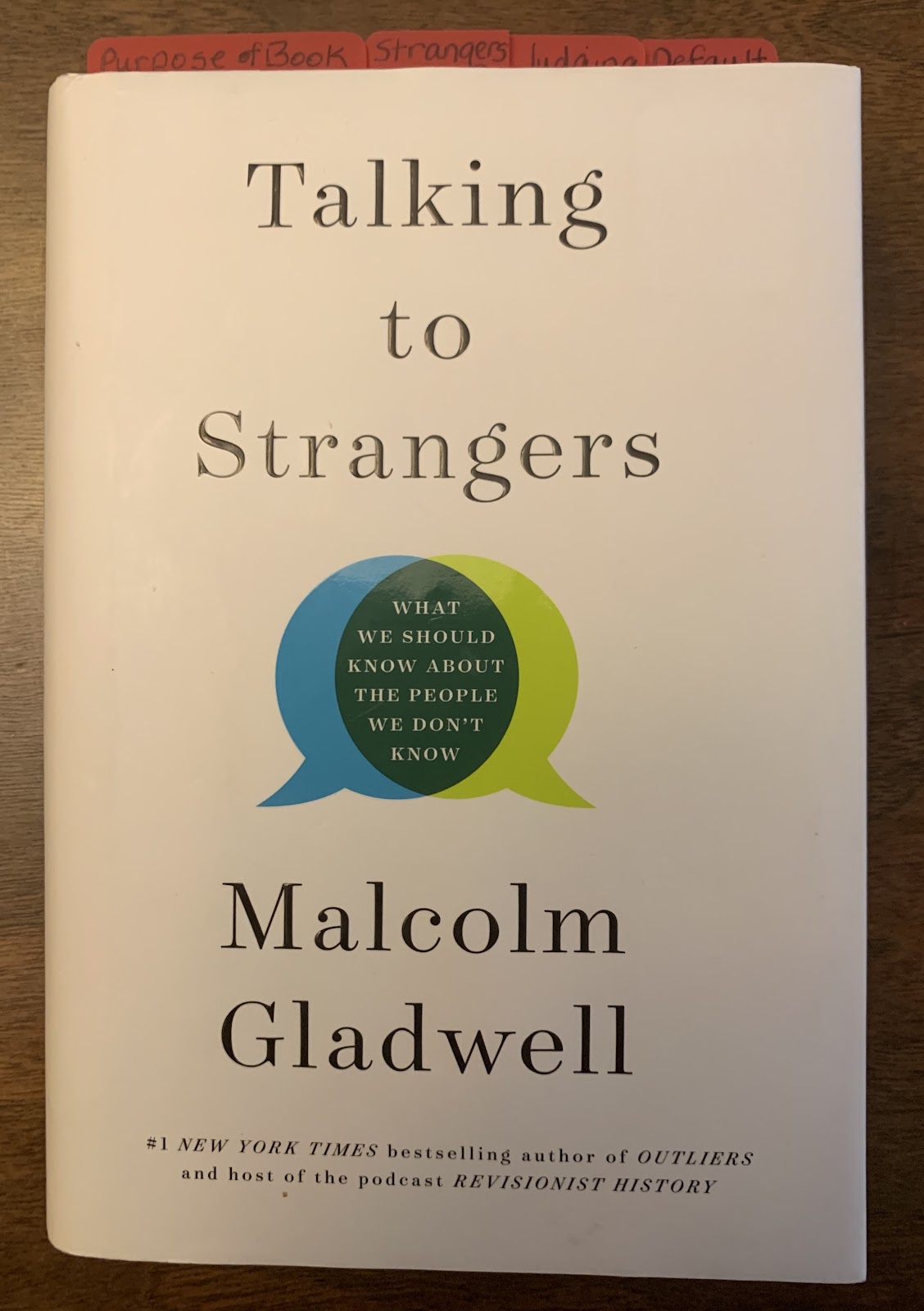
Malcolm Gladwell TALKING TO STRANGERS—What We Should Know About The People We Don’t Know

Assumptions. We all make them, and understanding why we create these thoughts in our heads, and yes sometimes the heart with strangers is made clear by author Malcolm Gladwell in his latest book Talking to Strangers. Here are the assumptions Gladwell referenced that gave me a reason to pause and rethink the assumptions I have made, and honesty here...still guilty of at times making.


“We think we can easily see into the hearts of others based on the flimsiest of clues. We jump at the chance to judge strangers(p. 50).

“You believe someone not because you have no doubts about them. Belief is not the absence of doubt. You believe someone because you don’t have enough doubts” (p. 78).

“If you don’t begin in a state of trust, you can’t have meaningful social encounters” (p. 104).

“Default to truth becomes an issue when we are forced to choose between two alternatives, one of which is likely and the other which is impossible to imagine” (p. 130). 

“I believed in you always until I couldn’t anymore...default to truth” (p. 131). 

“Transparency is a mythan idea we’ve picked up from watching too much television and reading too many novels where the hero’s ‘jaw dropped with astonishment’ or ‘eyes went wide with surprise’” (p. 162).

“Our strategies for dealing with strangers are deeply flawed, but they are also socially necessary….But the requirement of humanity means that we have to tolerate an enormous amount of error. That is the paradox of talking to strangers. We need to talk to them. But we are terrible at it” (p. 166).

“We need help with the mismatched strangersthe difficult cases” (p. 185).

“The fact that strangers are hard to understand doesn’t mean we shouldn’t try” (p. 260). 

“We will never know the whole truth. We have to be satisfied with something short of that” (p. 261).

“And that means that when you confront the stranger, you have to ask yourself where and when you’re confronting the strangerbecause those two things powerfully influence your interpretation of who that stranger is” (p. 285).

“Don’t look at the stranger and jump to conclusions. Look at the stranger’s world” (p. 296). 

“There is something about the idea of coupling--of the notion that a stranger’s behavior is tightly connected to place and context---that eludes us” (p. 311).

“We could start by no longer penalizing one another for defaulting to truth” (p. 342).

“There are clues to making sense of a stranger. But attending to them requires care and attention” ((p. 343). 

“And behind every one of those ideas are assumptions that too many of us shareand too few of us have ever bother to reconsider” (p. 345).

Gladwell makes each of these points through the retelling of relevant points with multiple historical misunderstood events from history and current events. Each of his poignant examples conveys the meaning of each of the quotes I have shared in succession from his book, Talking to Strangers. Although my thoughts into what I am experiencing today as a school leader, during the COVID-19 pandemic is connecting Gladwell’s thinking to what I am being asked to do to support our students and our teachers.

Moving forward through and past this pandemic I believe gives us a great opportunity to move beyond our assumptions to those we serve nearest our homes, community, and classrooms. We may not have the privilege of truly living their experiences, but we can certainly try to understand the world they are experiencing. Let’s give each other grace, care, and attention during this unprecedented time and skip our possible biased assumptions.

Monday, January 20, 2020

Lessons from Gus


Thomas C. Murray  Personal & AUTHENTIC—Designing Learning Experiences That Impact a Lifetime

What is it about reading stories with real people doing both ordinary and extraordinary acts of heartfelt service. The author of these events often carefully craft their words with ideas interwoven with a conviction and mindset that the reader can then replicate and apply them to who they are and what they too can do. Thomas C. Murray author of Personal & Authentic, Designing Learning Experiences That Impact a Life has this gift as a writer and storyteller as evident from the many narrative accounts he shares in his book, Personal & Authentic.
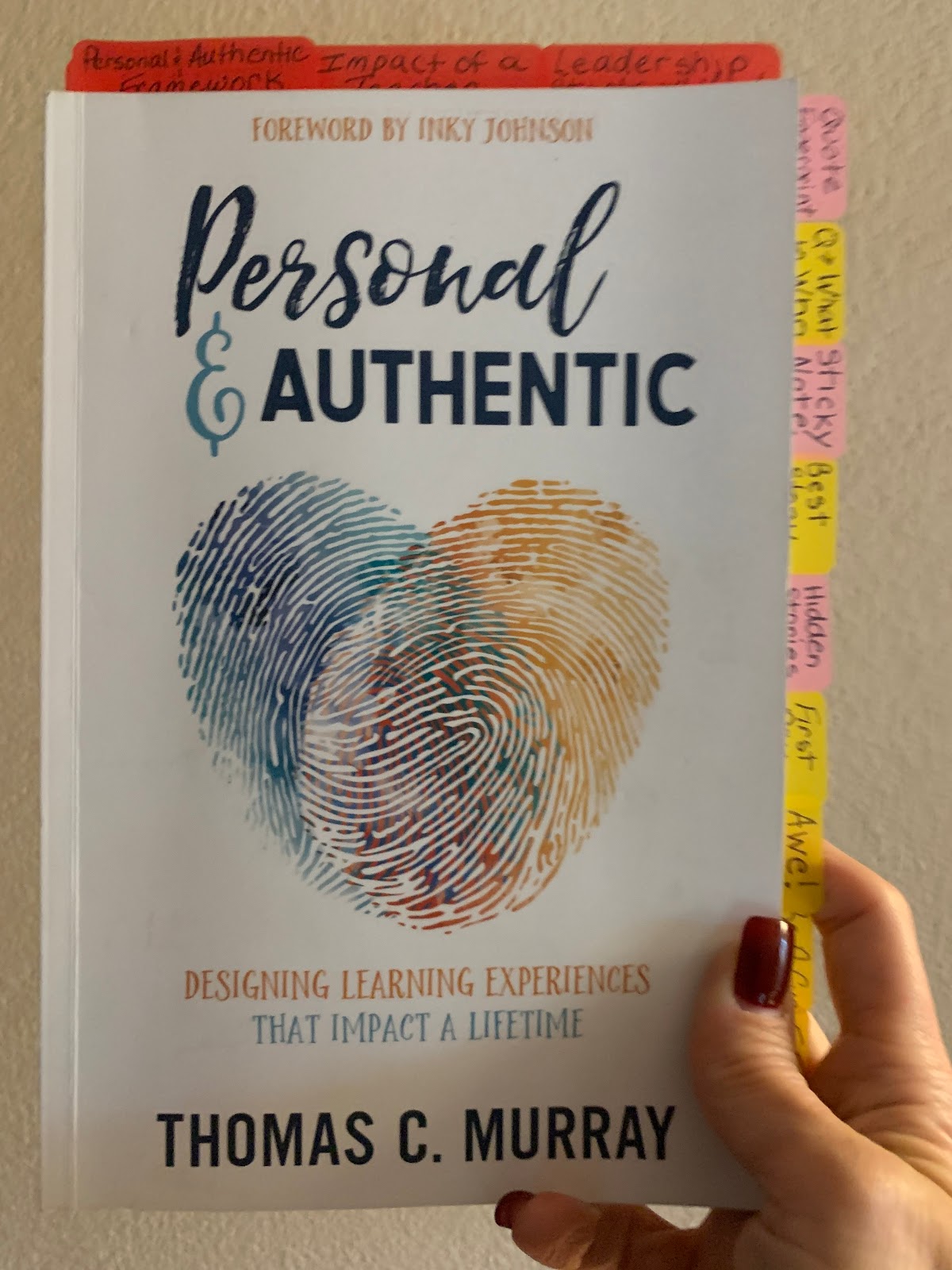
One of the most powerful stories Murray shared was a personal experience that occurred just moments after he left a busy airport at the peak of arrival and departures. Upon landing at his destination Murray was notified by friends and family he has just missed a round of violent gunfire at the same terminal he had just departed from. He had literally missed being in the crossfire as an unvoluntary bystander by mere minutes and was beyond shaken. Although physically safe himself, he had left behind more than one colleague and new acquaintance who had not yet caught their own flights and had remained in the destructive aftermath.

Murray like many of us understands this horrific event is occurring too often in our communities across the country but did not expect to experience it so closely. He was physically and emotionally shaken, and likely in a state of shock. Going through the motions of making his way home he unexpectedly heard an unknown stranger singing a gospel tune with a “deep southern male voice”. This compelling melody slowly gave Murray a much-needed sense of calmness and reassurance. Curious Murray then made his way over to this man who he later learned was a professional shoe shiner by the name of Gus. The song ended and Gus addressed Murry asking, “Can I help you today?” This simple gesture allowed Murray to stop, pause and collect himself and experience the unexpected. Murray shared, “I’ll admit, I sat there in awe. Those ten minutes with Gus caused me to reflect not just on education but on life itself” (p. 174).

Murray’s messages from each chapter in his book Personal & Authentic mirror the lessons he learned from his conversation with Gus. “These ‘Lessons from Gus’ give incredible insight into what being personal and authentic as educators are all about” (p. 175). The job Gus loved to do and did so every day with great enthusiasm was to polish, shine, and care for other people’s shoes in a noisy busy airport. Similar to the role of great teachers and leaders who teach, support, and care for children every day in complex school systems.

There are five important life lessons Murray walked away with during his brief encounter with Gus. The first and most important lesson is how we interact with those around us is incredibly important especially to those we serve. The education of a child begins, ends, and is filled with teachers and leaders. It is critical to remember, “Evey child that walks through our school doors in an opportunity. Make every interaction count” (p. 175). Your mindset matters and Gus modeled this with every interaction.

Next, Murray learned not only did Gus love to shine shoes, but he also loved his craft. He was passionate to do his best with every shoe every day. He knew he could make your shoes look their best with a bit of elbow grease. Murray reminded us of the value of being passionate about our work in education. “Let the love of your work so radiate that it inspires others to give their best. Be proud of what you do and the impact that you have” (p. 175).

Gus also made each detail matter as he polished Murray’s well-traveled shoes. “He exemplified a true customer service mindset” (p. 175). Gus believed he was the best and he prided himself in the details. Murray listed both personal examples as well as recommendations to “Make It Stick” from educators all across the country how we can “own our own actions and know they speak more than your words ever will” (p. 176). These details matter to our students, our teachers, and our families.


Gus absolutely loved serving others. Do we genuinely feel the same about where we head to work every day? Who do you spend your time with during these often unavoidable hectic wonderful days? Who do you choose to surround yourself with? We can hang out with Gus’s who inspire us to serve and support others or not. Murray challenges us to, “Surround yourself with positive people who have a can-do mentality and will lovingly push you to be better” (p. 176).

Finally, Murray reminds the reader to “Be Present” just as Gus did as he was polishing his shoes. “Gus made me feel like the most important customer in the world every moment we were together” (p. 176).  When we are surrounded by those we serve, remain focused on who we serve and why we do the work that we do. Murray quotes an educator I follow closely on social media and whose words and deeds mirror her actions. “In whatever you do, lead like you’re leaving your legacy. Every action and interaction that you have on a daily basis is something that people will carry forward for you when you leave” (p. 177), Jessica Cabeen, middle school principal, Minnesota.

“The work is hard, but our kids are worth it.
Be bold. Be fearless. Be proud. Be you.
Your story is not finished yet.”
Thomas C. Murray

Friday, December 27, 2019

Changing Students Relationship with Math


Jo Boaler Forward by Carol Dweck Mathematical Mindsets—Unleashing Students’POTENTIAL Through Creative Math, Inspiring Messages and INNOVATIVE TEACHING

I finally read Jo Boaler’s book Mathematical Mindsets. I’ve had it in my ‘to read pile’ for a couple of years now even though it was highly recommended to me by more than one educator. Carol Dweck wrote the Foreword and she shares, “Boaler is one of those rare and remarkable educators who not only know the secret of great teaching but also know how to give that gift to others.”


The book was indeed a treasure for me to read and an important reminder on the mathematical pathways we need to purposefully create for each of our students. Boaler reminded this reader, “Mathematics more than any other subject, has the power to crush students’ spirts…When students get the idea they cannot do math, they often maintain a negative relationship with mathematics throughout the rest of their lives” (p. x).

I want to enhance the experiences our students have with mathematics, and even more importantly frame their mindset so they embrace these opportunities rather than shying away from them. There are too many takeaways from the book to list here as you can see from the tabs in my personalized copy, but here are a few reminders that are just incredibly critical for all of to remember.

First, math is not just about numbers. It’s so much more than that. Mathematics is a mindset. “The new evidence from brain research tells us that everyone, with the right teaching and messages, can be successful in math…” (p. 4). In other words, how we teach and the messages we convey to our students while we are teaching matters...a lot. Starting with changing the way students feel about mistakes. “When we teach students that mistakes are positive, it has an incredibly liberating effect on them” (p. 15).

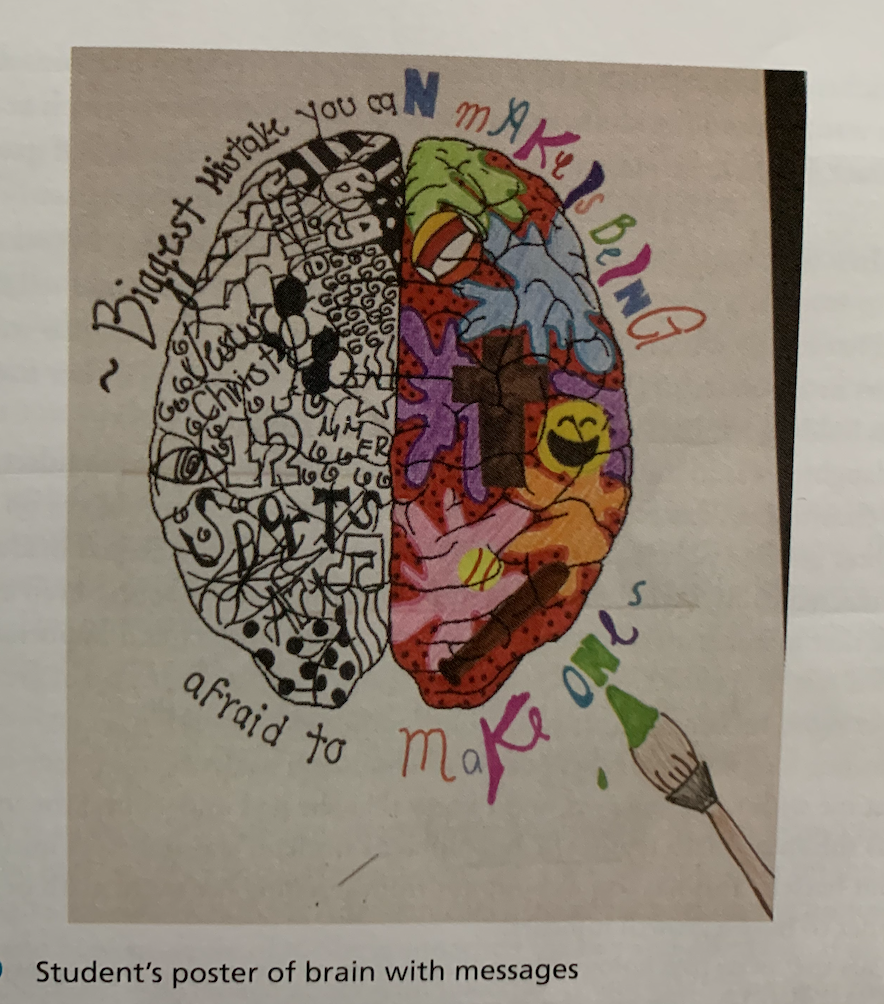
Boaler shared a teacher’s example of how she helped her students understand that mistakes are a way for the brain to make connections, learn, and growth...literally. Students were asked to take a perfectly smooth piece of paper, smash into a ball based on the frustrations they have when they make a mistake in math, smooth the paper back out, and draw colored lines where creases were created. She likened the scattered colored lines to the growth that occurs in the brain when a mistake was made. The students were then required to keep this piece of “brain art” into their math notebooks as a reminder of what happens to the neurons and dendrites in their brain when they make a mistake...they grow and connect.  One student’s brain art said, “Biggest mistake you can make is being afraid to make one” (p. 17). There is so much truth in this statement.


Next, Boaler reminds us a mathematical mindset is not a passive activity. Students must see their role as active participants, trying to understand and make sense of numbers and the patterns they create in the world around them. This productive struggle “number sense and mathematical mindsets develop together, and learning about ways to develop one helps the development of the other” (p. 36). Teaching students their disequilibrium of what they know and what they don’t know yet will be a constant theme while learning, but risk-taking and collaboration with others will be valued.

Moving away from redundant math facts and mindless homework “practice” into engaging relevant tasks that give students multiple opportunities to show what they know starts with how teachers facilitate student’s learning. Rather than walking the reader through an abstract explanation of math instruction, in chapter five she provides five examples from schools across the country who purposefully planned rich mathematical tasks and the impact it had on student motivation and engagement. Boaler states, “These are all cases that I have personally witness among groups of people and that have given me important insights into the nature of the teaching and tasks that bring about such learning opportunities” (p. 58).

The case studies demonstrate how teachers create mathematical excitement and offer critical insights into students discovering the openness of numbers, the power of visualization, making connections, and moving beyond memorization and speed of computation. I know this will be the go-to chapter for teachers because Boaler also shared how to strategically design tasks that create and encourage excitement about mathematics including thinking about how to...
  1. Encouraging multiple methods, pathways, and representations...more than one way.
  2. Encourage inquiry...What if?
  3. Ask before modeling...curiosity is a great motivator.
  4. Use visuals...make it tangible.
  5. Make it low floor and high ceiling...think accessibility for each student.
  6. Can students convince and reason to a partner or group...be skeptical.
Then, Boaler also bravely addresses equity. “All subjects extend to difficult levels; the reason so many people think math is the most difficult is the inaccessible way it is taught. We need to change the thinking around this if we are to open mathematics to many more people” (p. 96). Developing a mathematical mindset should be an opportunity provided to each student. To make math equitable Boaler recommends…
  1. Offering high-level content to all students.
  2. Changing mindsets on who can achieve in mathematics.
  3. Encouraging students to go deeper with their thinking and reasoning.
  4. Moving out of isolation into a collaborative setting.
  5. Providing more positive framing and encouragement to girls and students of color, and
  6. Forget homework…enough said.
Finally, there are times when I read a book and I am so overwhelmed with the ideas and content, but this was not the case with Mathematical Mindsets. I felt a sense of relief when I read the final chapter because Boaler provided a pathway on where to start to support all students developing an appreciation for mathematics. “In this chapter I will provide a set of teaching ideas, drawing from throughout the book, that can help you create and maintain a growth mindset mathematics classroom” (p. 171).

As Boaler’s subtitle states, “unleashing students’ potential through creative math, inspiring messages and innovative teaching” is an opportunity we should all prioritize for our students as learners now and as they continue to learn.