Saturday, July 18, 2015

School Leaders Guide to a REAL PLC

Richard DuFour & Rebecca DuFour THE SCHOOL LEADERS GUIDE TO PROFESSIONAL LEARNING COMMUNITIES AT WORK—Essentials for Principals


There have been a substantial amount of publications around the practices of a true professional learning community (PLC). I consider Richard and Rebecca DuFour the co-founders and front runners of these effective practices centered on student learning. The School Leader's guide to Professional Learning Communities at Work focuses specifically on the role of the building principal. It is a condensed read of less than 100 pages with links to on-line ready to use tools to move the thinking into collaborative conversations with staff.

Each chapter thoroughly and quickly reviews the commitments and responsibilities of a building principal to lead a PLC. The DuFours remind the reader, "It is not a meeting" or a "book club" (p.4). It is "an ethos that infuses every single aspect of a school's operation" (Hargreaves as citing in Sparks, 004, p. 48). My book is already worn and referenced for our focused work ahead as we implement year two of a school improvement turnaround grant.

The section in the DuFours’ School Leadership Guide is what I am most excited about.  This free on-line template is for the principal to use, "for the collective dialogue that takes place on a collaborative team after each common assessment” (p. 52). This is not only to ensure each student is learning, but you are using the "actual evidence of student learning" (p. 53) as the tool to facilitate the conversation of the essential learnings for the students, evaluation of the formative assessment, and to determine the instructional strategies’ effectiveness. Yay!


The DuFours conclude their book with this quote. "This is the role of the principal, a role that is daunting, but doable” (p. 89). I would add the role of the principal is also incredibly rewarding when you impact student learning and teacher effectiveness with shared ownership!


Monday, July 6, 2015

The Real Crisis in Education

David Hursh HIGH-STAKES TESTING AND THE DECLINE OF TEACHING AND LEARNING—The Real Crisis in Education


It's a mad, mad, world out there and everyone is fighting for a piece of the pie. Education is no exception. David Hursh's book High-Stakes Testing and the Decline of Teaching and Learning poses a strong argument for how education is becoming more complicated and political than previously imagined. Specifically, "we decreasingly think about democracy and our commitment to one another in terms of community and the common good, and instead conceptualize democracy as the individual rationally choosing within a competitive marketplace" (pg. 7).

Hursh is passionate about supporting the clarity of thought on how neoliberalism in education is doing more harm than good to our school systems. His "goal is to describe what is possible, to critique the increasing emphasis on markets, accountability, and high-stakes standardized testing, and to describe what we might do to reclaim education as a profession" (pg. 7). He uses in own experiences as a student and as a teacher in both public and private school to argue how schools should work and what students should be doing. He uses examples of what it looks like using schools in New York and Texas, and what it should not look like with reference to Chicago's inner city schools. Hursh continues to reference how our educational system is creating a society in our country that has now shifted to support a competitive global economy rather than collaborative supportive society.

Hursh revisits the No Child Left Behind (NCLB) Act, which he believes contributed to our neoliberalism educational system by created mandated state standards, testing requirements, and school accountability measures. Specifically, "Standardized testing is promoted as a means of assessing the quality of students, teachers, and schools, thus ensuring that all children are treated fairly" (pg. 85). "Furthermore, NCLB promotes the view that like other neoliberal reforms, we have no choice but to submit to the discipline of the market, rather than relying on process of deliberative democracy" (pg. 95). We all get to have the pie, but not select the flavor.

Although I don't agree with many of Hursh's views I applaud his unwavering efforts over the lifetime of his career. He states in the last chapter, "I want to reassert the possibility of a society and schools that support community welfare and the public good over corporate profit, and propose how we might work towards those goals" (pg. 122). He suggest alternatives to neoliberalism in education including, refusing to buy into adopting neoliberal reforms due to globalization and by allowing individual choice of where and how we receive our education. Hursh also address the importance of actively collaborating together when developing educational policies. This way all of our children receive an equitable piece of the pie.

Thursday, July 2, 2015

Your Twenties Do Matter

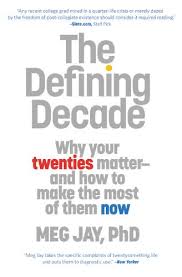
Meg Jay, PhD THE DEFINING DECADE—Why your twenties matter--and how to make the most of them now.
Our twenties only happens to us once, and what we do during that time matters more than most of us thought. That is the premise of clinical psychologist Dr. Meg Jay's book The Defining Decade , Why your twenties matter--and how to make the most of them now. These years are much more important than the current "hype" we hear in magazines, social media, and in popular conversations.

Dr. Jay helps the reader understand these years are a "defining decade" (pg. xv) and what we do with them determines our pathway into later adulthood. Dr. Jay encourages those in their twenties to use  this time wisely and with purpose to propel oneself into where and who we want to be. In each of her sections, "Work," "Love," and "the Brain and the Body", the reader learns more about why "thirty is not the new twenty" (pg. xxvii). Using current research on the adult brain learning theories she supports the thinking that during our twenties we have optimal opportunities to create the pathway to a purposeful and meaningful life.

Although I am well past this period in my own life I have adult children in this stage of optimal personal and professional development. How to share this information becomes a delicate dance. Pushing too hard into this conversation they pull away and look to other resources to validate their reasoning. Waiting for the right opportunity becomes the better solution. Dr. Jay refers to Carol Dweck's, growth mindset way of thinking. "For those who have a growth mindset failures may sting but they are also are viewed as opportunities for improvement and change" (pg. 158). Building your "identify capital" at home and in the work force (pg. 3), by developing new connections with "weak ties" (pg. 17) can make the unthought known" (pg. 33) to build a "customize life" (pg. 54) so your life actually is better than what you find on Facebook (pg. 41).

Here is a summary in Dr. Jay's own words on TedTalk:  http://www.ted.com/talks/meg_jay_why_30_is_not_the_new_20?language=en


Sunday, June 21, 2015

FACES

Lyn Sherratt & Michael Fullan PUTTING FACES ON THE DATA—What Great Leaders do.
School Improvement is hard work, but if implemented with what research tells us what works, it's becomes the right work. Lyn Sharratt & Michael Fullan remind the reader about how much more meaningful this work can be if you associate the names and FACES of our students. Looking back at our first year of implementation of our own school improvement process, it just makes sense. Betty, George, Carter, and Savannah and all of students have their own set of data. "Building the bridge from data collection to improved instruction"  (back cover) are what Sherratt & Fullan say "What Great Leaders Do!" (front cover). 

Sherratt & Fullan shared their research "about how the use of student achievement data is a powerful tool for improvement at every level--especially if improvement is noted and monitored on the basis of drilling down in that data to individual student names and FACES in individual classrooms" (pg. 6-7). They looked at 17 schools in improvement and identified nine schools who were able to continue and sustain their achievement efforts. 14 Parameters were identified as commonalities in these schools and Sherratt & Fullan have established these as "drivers of reform and practice in successful school districts" (pg.10).

It would be tempting to start with this list and move on with developing your school improvement plan, but Serratt & Fullan drilled down even deeper with further research to determine, "which practices are so effective they become nonnegotiable" (pg. 29) in every classroom? Specially, how do they make the overwhelming amount of data relevant so we can have a greater understating of what to do and where to start.

At this point I made the connection to Simon Sinek's work, "Start with the Why."  and possibly Sharratt & Fullan were thinking this as well when they developed their research questions to "cluster the parameters" (pg. 41). To zero in on putting the faces on data, these are the important things (questions/drivers) great leaders do" (pg. 41).
 
Why do we put FACES on the data?  -- All students have the right to learn.
How do we put FACES on the data?  -- Assessment & Instruction
What leadership skills are needed?    -- Knowability, Mobilize-ability, Sustainability
Where does this happen?  --  Ownership with students, teachers, parents & the community

My Take-A-Ways:
This should be a must read for every principal in school improvement. If anything just to frame ones comprehensive achievement plan and to support the intense focus needed for equitable growth and achievement for both students and staff. Here are some of my favorites on what Sharratt & Fullan learned about Assessments, Instruction, and Leadership from their case studies:

  • Learning Goals & Success Criteria
  • Thick Thinking
  • Descriptive Feedback
  • Questions for Students
  • Data Walls
  • Components of an Effective Literacy Program
  • Authentic Tasks Defined
  • The Power of Writing
  • Staff Data Binder
  • Co-Teaching Cycle
  • Collaborative Inquiry Cycle (PLC's/Data Team)
  • HIGHLIGHT: Core Principles for School Improvement

Sharratt profoundly stated "Data today is instruction tomorrow" (pg. 89). I would add our students today are our future tomorrow.

Sunday, May 31, 2015

Awareness, Action, Assess, Adjust

Pete Hall & Alisa Simeral TEACH, REFLECT, LEARN—Building Your Capacity For Success in the Classroom

The end of our school year is quickly coming to a close. With just weeks to go, my email inbox seems to be innovated with reflective surveys from partnerships, district support staff, publishers, and colleagues. There is no doubt each of these tools would provide insightful data and possibly new thinking to support our prioritized school-wide goals. Although with limited time left I want to be mindful of selecting the resource that supports the thinking of, what we do in our classroom matters.

High on my list is the instructional reflection tool in the book, Teach, Reflect, Learn.  The authors Pete Hall and Alisa Simeral have developed a continuum for teacher's ongoing reflection to support the heart of their work, providing high quality reflective instruction collaboratively developed by teacher teams.  In summary, work smarter not harder, in collaboration not isolation, by closing the knowing doing gap, and "building our capacity for success". Great teachers take charge in their own professional learning by improving their impact with what research tells us is most effective--teacher quality.

Many researchers have prioritized teacher quality in their life's work.  John Haiti's "Know thy impact!" and Richard DuFour & Robert Marzano stated,"Schools must utilize strategies that result in more good teaching in more classrooms more of the time" (2011). "And since yielding high levels of student learning is our ultimate goal, our collective charge right now is to improve our professional practice" (Hall & Simeral p.13).

Hall & Simeral created The Reflective Self-Assessment Tool for educators "to be thoughtful, intentional and reflective about your practice" (p. 21). Using the Self-Assessment "propels us forward" by identifying "four components that are critical to clarifying how we think and how our thinking affects our professional performance".

Reflective practitioners:
Have awareness of their instructional realities.
Are intentional in their actions.
Accurately assess their impact.
Adjust their actions on-the-fly.

The authors encourage teachers to take the six-week challenge to build an awareness of where they fit on the Continuum of Self Reflection. Although the authors do caution it is important to remember we never really finish. "As we develop and strengthen our skills and habits, we flow along the Continuum of Self-Reflection" (p. 42). The power is when we are honest in our awareness.  "We start with becoming introspective and building awareness of what we know and what we don't know" (p. 47). Our learning comes from the road we travel, not crossing the finish line.

Saturday, May 16, 2015

Up

Andy Hargreaves, Alan Boyle & Alma Harris UPLIFTING LEADERSHIP—How Organizations, Teams and Communities Raise Performance


Author's Thoughts:

Uplifting leadership is based on a seven year study from a diverse group of global communities including leaders from business, sports and schools. These author's extensive research defines the practices of an "uplifting leader" in action. They have what "it" takes to make "it" happen without quickly racing or pushing people or by pursuing milestones to be on top. "What the organizations and leaders we studied did do was to engage in a process of uplifting leadership involving six interrelated factors that composed a journey to improbable success" (pg.9).

Uplifting leaders:
  • Dream with Determination in a moral fight for what they believe.
  • Demonstrate Creativity and Counter-Flow to think in and outside of the box.
  • Collaborate with Competitors to share innovation and to propel everyone forward.
  • Push and Pull to build and develop shared ownership and responsibility.
  • Measure what is Meaningful and what matters.
  • Sustain Success for now and in the future.
Uplifting leadership:
  • "Is the beating heart of effective leadership" (p. 3).
  • "Is a collective force that leaders create together to raise everyone's prospects" (p. 4).
  • "Is an "insatiable desire to learn along with the uncompromising demand for success (p. 6).
Uplifting leadership is a direction and a process for "enduring achievement" (pg. 7).

My Thoughts:

This is hard work to harness and harvest ones dreams. It requires an Uplifting Leaders to:
  • Encouraging creativity but with a mindset to be innovative around what we know research tell us works.
  • Engage in on-going collaborative conversations around what we can do together, not what we have no control over.
  • Pushing forward with a belief in those doing the work and pulling them forward towards new thinking.
  • Measure what matters most relentlessly and revisit it frequently to make our impact meaningful.
  • Develop teachers as leaders to uplift all of our team leadership capacity.

Uplifting leaders make the dream into a sustainable reality for our students now and the ones who will join us.