Sunday, March 10, 2019

Our Calling as Learners Who Teach/Lead

Brad Gustafson RECLAIMING OUR CALLING —Hold on to the HEART, MIND, and HOPE OF EDUCATION

I learned about a group of educators who would be reading Reclaiming Our Calling by Brad Gustafson on Twitter. The author and an invited guest would facilitate an online conversation about the book through a Facebook Live event first immediately followed by a Twitter Chat. Both discussions were to be held in the evening for about an hour. Online participants could join these interactive conversations in both social media platforms or the one that worked best for them. The author and invited guest would start the conversation with key insights from the assigned chapters and participants could then jump in with comments on Facebooks or Tweets on Twitter. I was totally intrigued by the process.
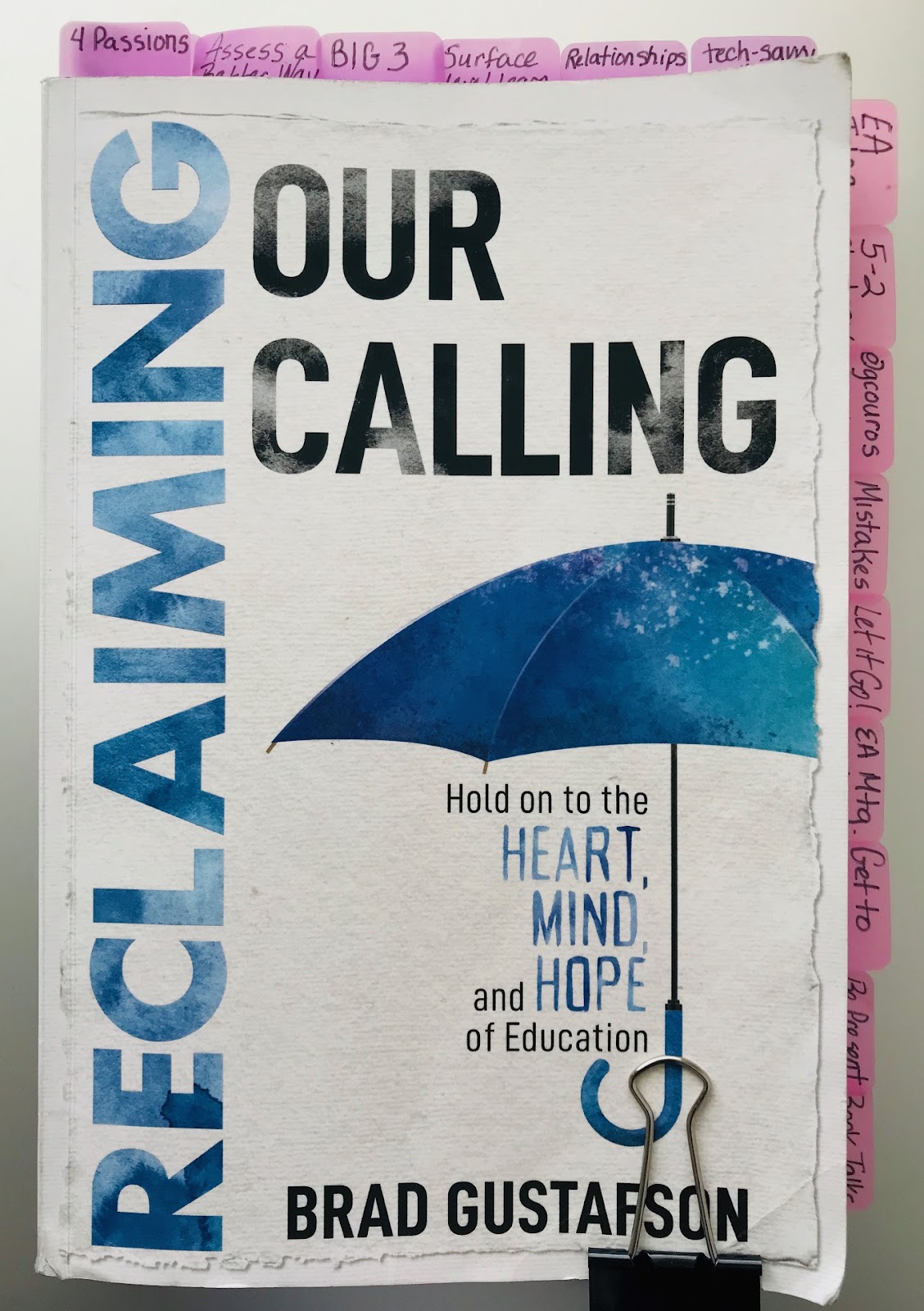
As building principal who often lives in isolation when it comes to professional learning I was all in to try a new approach. This is the second book for Gustafson, and I was already familiar with his drive and relentless focus to create positive and meaningful experiences for students and staff. In this book, Gustafson shares four passions on how educators can “Hold on to the Heart, Mind, and Hope of Education” and how to adhere to our “Moral Foundations” of teaching and learning by “Reclaiming Our Calling” and keeping students at the center of our work.

The weekly online conversation centered around how to enhance and prioritize relevant learning experiences for our students and staff during the Facebook Live event, as well as the Twitter Chat. The professional learning for me came when I was able to listen and learn from educators all across the country as we shared out takeaways from assigned chapters. I was reminded of proven practices, gained new insights, and was constantly reminded what we choose to do in our role as educators matters a lot to our students as well as the staff we willingly serve. Here are a few of my favorite takeaways from the four passions.

Gustafson reminds the reader “The Core of Our Calling” is “Learning that Lasts” (p. 40). To make learning “stick” for our students we’ve got to understand what is important to them as learners. To do this we must be more intentional with the discussions we have our students. “The conversation is the work.”...The important work of building relationships is done through conversation. It’s accomplished by being present and creating a place for students to be curious” (p. 62). Message for me...get into classrooms more often, sit down with students, discover their hopes, passions, and interests and make those incredibly important connections. By discovering what is relevant or important to them, I can then help them navigate where they can contribute and gain momentum to their own learning in order to make school not something they do, but experience.


Conversations with staff matter too AND being truly present when you are having them. Gustafson writes about educators who write personal reminders to themselves by writing “5-2” on their to-do lists. “The numbers represent the goal of having at least five meaningful conversations with individual staff members and writing two personal thank you notes each day. When we remind ourselves of what is real and write down what we want to stand firm on, we’re more likely to follow through. I’d like to challenge myself to do this with staff but morph it a bit and challenge myself to have five conversations with students each day as well, and write down two things I’ve learned in my school picture photo album. Not necessarily just to connect, but discover their dreams and interest. “When we start with relationships and practice acts of intentionally, we honor the whole leaner…” (p. 61).


I must admit my day as a principal can be extremely long and I am guilty of going into autopilot in order to accomplish the prioritized tasks I set out to do each day. Gustafson offered several strategies to “short-circuit” our autopilot mode. “It may sound simple, but the first strategy to short-circuiting your autopilot mode is to do something different each day to disrupt your routine” (p. 146). He recommended making small changes first before implementing change on the grand scale including being “more intentional about connecting with different students” (p. 147) and I’ll add staff. Which is why I am hopeful my morphed 5-2 strategy doesn’t just become an item on a checklist, but an opportunity to connect with our students and staff.

Although in order to do so I’ll need to be mindful of Gustafson’s strategy of being fully present to avoid autopilot mode. “Make it a habit to be mindful of where you are and whom you’re with” (p. 162). Including for me to physically stop moving, texting, speed walking, etc. and to get down to where students are at, look into their smile and lean in and listen. “The very best educators are able to see the perspectives of others while being able to navigate the system to meet the needs of their students. And the best way to understand somebody else's perspective to be fully present when you’re in the same spaces” (p. 160). Admittedly hard for me to do!

There are many more important “Passions of the Profession” in Gustafson’s book I highly recommend for teachers and administrators to revisit and consider, but my favorite really is found in his “Donut Theorem” (p. 178). He relates the crust of a donut to the (teaching and leading) traits we have, to do the work we love. The crust is incredibly important, but not near as wonderful as the jelly. “Your jelly represents your passions, curiosity, and strengths” (p. 179). My jelly continues to become a leader who provides avenues for teachers to become champions and implementors of effective instructional literacy practices in their classrooms at every opportunity. Every child deserves the right to be and become a reader in whatever avenue works for them as a learner.


It’s not often I carry around the same book with me for weeks at a time, reading a passage again, marking the text further, and making plans. At the end of our book study, a question was asked by Gustafson, “What are you going to do with the book?” Other than committing to making the changes I’ve shared in this post, I’ve purchased the book for a colleague I respect and admire tremendously and selfishly so I can lean in and learn, in order to continue to reclaim my calling as a learner who leads.

Saturday, January 26, 2019

What If...


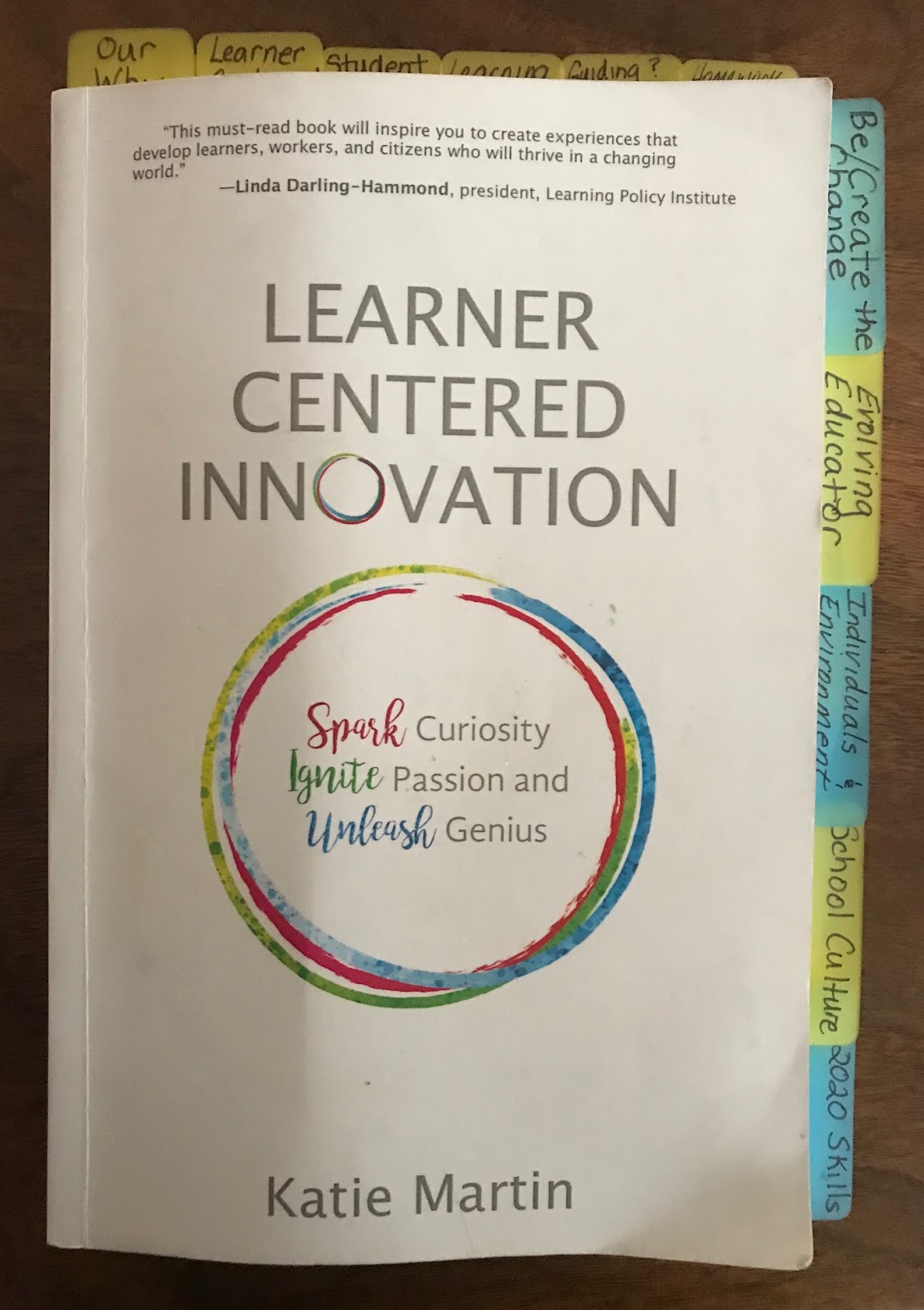
Katie Martin LEARNER CENTERED INNOVATION—Spark Curiosity, Ignite Passion
and Unleash Genius


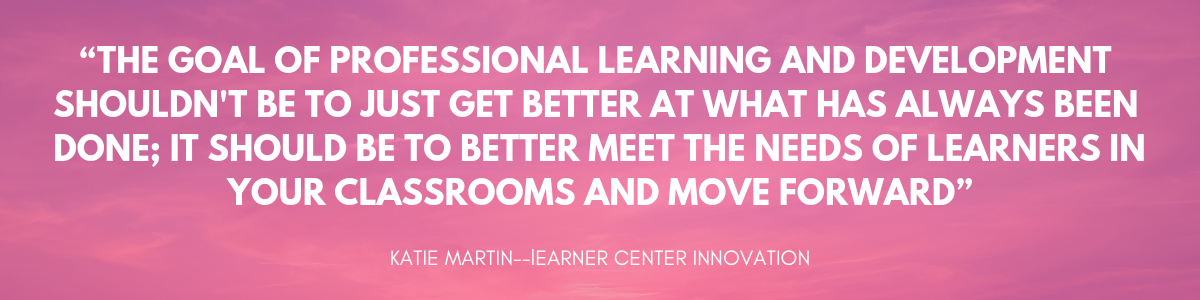
I am just pages away from finishing Katie Martin’s book Learner Center Innovation, Spark Curiosity, Ignite Passion, and Unleash Genius and I’ve reached yet another section in the book that is leaving me incredibly inspired as a leader to well...do better.  The preface in Martin’s book encourages the reader to “Be the Change” and start to reframe what learning looks like in our schools and classrooms by asking the question, “What if?”
Although Martin also encourages the reader to remember, “The role of you, the reader, is not to just consume and copy my ideas or the ideas of other I will share, but to dive in, question, create new meaning and ultimately ask ‘What if?’ and begin to create the change that you wish to see in your context” (p. 14-15).
There was a multitude of innovating ideas I came away with to do and be a better leader. The one idea that is keeping me up at night…in a good way was found in Chapter 10, “Better Together.” Martin shares a personal experience when she joined a Professional Learning Community (PLC). The team was moving through the motions of answering the essential questions of a PLC and diligently completing the form and minutes in order to turn in their completed task. Her experience sounded too familiar and caused me to genuinely reflect on what I have been asking teachers to do regularly.
Then my “ah-ha” occurred when I read the next sentence. “How much more useful could that meeting have been had the focus been on using their questions to delve into ways to improve their practice?” The essential questions of a PLC are nothing less than brilliant in my opinion, but Martin reframed innovation for all of us by stating, “The questions they asked are great if they are used to guide and investigate practices and to collaboratively explore new and better ways to meet the learners’ needs. Moving the PLC process from“compliance-based cycles to cycles of learning that empower teachers to improve their practice and meet the needs of the learner.”
“Imagine the same cycle, but (what if)…
  • Instead of focusing on the right answers, teachers have the opportunity to experience new models of learning and shift their thinking about what is possible in the classrooms.
  • Based on new experiences, teachers work together to select goals and research what works in their classrooms with their learners.
  • They determine the best evidence to gather and analyze based on their goals.
  • Teachers collectively provide and receive peer feedback and support to improve based on the shared vision, their goals, and the needs of their learners.
  • This kind of cycle ensures that the vision and goals for learners remain the driving force for professional learning” (p. 260). 

Martin gives the reader critical items to seriously consider during a cycle of inquiry. “Trust is imperative to empowerment, but it should not be confused with abandonment” (p. 268). This cycle of inquiry requires balancing the structure of a learning cycle (in my case the essential questions of a PLC within the framework of the data team process), and the collective inquiry of professional learning of our teams. Building collective efficacy not only prioritizes the professional relationships we develop and the diverse experiences we each bring to the conversation in order to  “create the right kind of culture, which requires prioritizing time and experiences that help us grow” (p. 271).

The cycle of inquiry is just one of Martin’s recommendations to “spark curiosity, ignite passion, and unleash genius.” Martin's book also includes multiple ideas for not necessarily doing more but being more purposeful and framing “the why” we need to keep our learners at the center of innovation.

Sunday, January 6, 2019

A Must-Read for Each School Leader

Jeanne Spiller & Karen Power LEADING with INTENTION8 Areas for Reflection and Planning in Your PLC at Work


As a school leader, I am continuously on a path to refine and improve my leadership skills to facilitate learning for both our amazing students and staff. Spiller and Power, authors of Leading with Intention have generated a tremendously practical resource for school leaders to use while “reflecting and planning our work” to enhance learning. In each of their eight chapters, they have culminated an area of practice found in the PLC process as defined by DuFour and Eaker as, “An ongoing process in which educators work collaboratively in recurring cycles of collective inquiry and action research to achieve better results for the students they serve.”

I found two ways a school leader could read Spiller and Power’s book Leading with Intention. You can read each chapter in succession to reflect on the leadership practices that are needed and which leadership practices to avoid to facilitate learning. The chapters can also be read individually as the reader prioritizes the leadership steps needed to refine their school’s PLC systems. I also thought of it as an excellent reference tool to continue to go back to as we progress in “achieving better results for the students we serve."

Chapters topics include strategies on how to achieve focus and stay intentional. Honestly, this is hard to do when there is just so much to do. ”The struggle is real.” The authors also discussed the “systems and protocols” needed to “establish and maintain organization” including, “practices that focus on trust, respect, and belonging.” The saying goes, it’s not what you do, but how you do it. These chapters speak of this truth.

Confession, Karen Power is a colleague and I could continue to hear her voice loud and clear when reading the chapters on shared leadership and using evidence for decision making and action. These two chapters I continued to re-read to glean a greater understanding on how to “build the team”, create “shared leadership among staff members”, and “guiding the team” in “taking collective responsibility for student learning.” Personally, this has been the greatest reward for me as a building leader...to see teachers take ownership of student learning by prioritizing the essential questions of a PLC embedded in the data team process. These chapters helped me refine my leadership skills.

Another chapter discussed the importance of prioritizing each student. Each being the keyword followed by a chapter on leading instruction for improvement.  I came into this role as a building principal because I wanted all teachers to lead in their classrooms with the knowledge needed to be instructional leaders. The authors guide the reader on how to “focus on instruction in a PLC” in a “positive classroom environment” through collaborative inquiry considering “an equitable learning environment” which includes “equal access to learning for all students in a school."

Finally, the last two chapters remind you of the value of "fostering communication" and "developing community and relationships". “Strong communication skills are a key feature of powerful leadership” which includes developing “productive listening habits” to develop “deep understanding” in order to have the “crucial conversations” needed when “stakes are high..opinions vary..and emotions are strong.” Communication is often referenced in many leadership books, but the authors clarify the communications skills needed for school leaders in order to have meaningful conversations on student learning. Putting “the why before the what” “people are more likely to understand the work and commit to it.” Whew! This is the hard part and it takes a commitment from a leader to level up one’s leadership “in the spirit of whatever it takes.”

At the end of each chapter, I used the reproducible tool provided for the reader to record their “current reality and next steps.” Key components of each chapter list a reminder of what great leaders do and what great leaders avoid. Writing my reflections as I read provided a perfect opportunity to record my thinking and plan my next steps to drive the change for our school improvement plan. Here are a few of my insights.


One Awesome Thing

Sara Pennypacker WAYLON—One Awesome Thing (Pictures by Marla Frazee)


Our school selected the book Waylon, One Awesome Thing to send home with each of our students over winter break. The goal was to have them read it as a family and enjoy their time together. The book was recommended highly by our instructional coach and our Title I reading teacher. I had not read the book before, but I trusted their recommendation this would be a perfect fit for our students.

I quickly discovered I need a better word than perfect. The author’s message has many important themes including friendships, family, acceptance, and yes quiet purposeful leadership. I imagine a young reader finding the author's words encouraging and even inspiring. This book leaves this adult reader hopeful for young readers to discover examples of how to look at themselves as individuals with unique strengths to lead and discover their own pathways.

Here are a few treasures from Waylon that inspire the reader no matter the age.


Sunday, October 14, 2018

Mindframes Matter


John Hattie & Klaus Zierer 10 MINDFRAMES for Visible Learning—Teaching for Success

I read John Hattie’s books initially as a teacher and now as a principal. I was excited to read his latest book 10 Mindframes for Visible Learning, Teaching for Success by Hattie and co-authored by Zierer because it offered a different perspective for students, teachers, principals, and district administrators. “The question this book addresses is related to the one big critical idea underlying success in making a difference to the learning lives of students--the mindframes of the educators” (p. xx).


Hattie and Zierer inform the reader educational expertise are both about competence and mindframes. “Expert teachers have answers not only to the question of what they are doing but also to the question of how and why they are doing what they are doing” (p. XV). Mindful teachers evaluate their impact by asking themselves how to “change and challenge” their current teaching practices so all students can improve. Mindful teachers evaluate how they collaborate through feedback, dialog, and building trusting relationships in order to develop a “learning focus”. Most importantly, mindful teachers continually reflect on the value an equitable impact has on learning for each of their students. “A high degree of competence alone is clearly not enough to lay the foundation for expertise, nor are even the best of mindframes. The important thing is rather the interaction between competence and mindframes” (xvi).

The book was written for students who want to understand their own learning, as an instructional resource for teachers, a guide for principals in order to inspire and motivate teachers to work together, and for other administrators to understand the current classroom challenges with all of the above-invested participants. It is tempting to simply list the ten Mindframes followed by celebrating the brilliance and insights of each Mindframe and encourage students, teachers, principals, and administrators to adhere to the author’s evidence-based research practices. Although it so much more than that. At the end of the book Hattie & Zierer reference Dr. Martin Luther King Jr.  They reminded the reader Dr. King “did not proclaim “I have a strategy” or “I have a plan”; instead, he said, “I have a dream” (p. 166). Hattie and Zierer have strategically inspired a vision for educators to develop expertise through both competence and mindframes. Their vision includes the following 10 mindframes.


I am an evaluator of my impact on student learning.
I see assessment as informing my impact and next steps.
I collaborate with my peers and my students about my conceptions of progress and my impact.
I am a change agent and believe all students can improve.
I strive for challenge and not merely ‘doing your best’
I gave and help students understand feedback and I interpret and act on feedback given to me.
I engage as much in dialogue and monologue.
I explicitly inform students what successful impact looks like from the outset.
I build relationships and trust so that learning can occur in a place where it is safe to make mistakes and learn from others.
I focus on learning and the language of learning.
Hattie and Zierer said it best by sharing, “Successful teachers are passionate not only about the subject they teach but also about teaching and learning in general, about the learners, and about their profession. About their impact on their students. This passion is important not just for becoming a successful teacher, but also for remaining in this challenging profession and therefore, for remaining a successful teacher in the long run” (p. XVII).

Monday, September 3, 2018

Equity, Empowerment, & Outcomes

Dominique Smith, Nancy Frey, Ian Pumpian, & Douglas Fisher BUILDING EQUITY—Policies and Practices to Empower All Learners


I am starting my twentieth year in education this fall. How the years have flown by, and how much the classroom and the school learning environment has changed! Although, a bit of honesty here, the biggest change for me personally was the lessons and experiences that were not necessarily easy for me to look back on. Early in my career, I provided each of my students with an equal amount of resources in the form of time, materials, activities, and curriculum. Although my intentions of fairness were sincere for all of my students to grow and learn. Wisdom learned…not each of my student’s experiences were equitable.

As I started my administrative pathway, I heard a quote that continues to push my thinking forward today. It spoke of equity not defined by access, but by outcomes.  My determination to understand how to ensure equitable outcomes for each of our students is one of the reasons why I picked up the book Building Equity, Policies and Practices to Empower All Learners by Smith, Frey, Pumpian, and Fisher. After devouring the book I was not disappointed as well as reassured what was defined as fair in years past has evolved. The authors share their definition of fair and equal as,

“Today, we think of fair as being not just equal but equitable…Whereas equal means everyone gets the same treatment and services as everyone else, equitable means each person gets what he or she need to succeed” (p. 2).

The authors developed an Equity Taxonomy built on five levels of “practices and outcomes that support critical standards of equity in a school or district” and are outlined in their first five chapters of their book. The levels are not necessarily linear but connected and more effective when purposefully interlinked. The taxonomy levels include the physical integration of student’s differences and experiences, accessing the needs of the whole child’s social-emotional engagement, and having multiple opportunities for students to engage in deep learning by providing instructional excellence to engage and inspire learners.

What I appreciated most from the authors were the examples of schools and educators across the country who are engaged in building equity. Their stories were insightful and left the reader with more than one way to move from teaching practices we have “done” with our students towards empowering each student as learners. Here are three ideas I want to commit to that were shared in the book that can provide more opportunities to build equity in our school community starting with purposeful actions by this administrator.
  1. Relationships. Relationships. Relationships. Hattie’s positive link to a student-teacher relationship with achievement has an effect size of 0.72, indicating a potential equivalency of two years’ worth of growth for our students. One way I can begin to ensure this happens is to connect those students who have difficulty with social-emotional engagement with a caring staff member. Although I have tried this before, I need to develop systems to consistently provide these dedicated staff members opportunities to share their success and get a recommendation from each other on what is working for them as they continue to connect and build relationships with our students. I also want to prioritize the relationships staff members have with each to be just as valuable as the relationships we have with students in our school culture.
  2. Students definitely know you care and are vested in them when you know their name and use it regularly. This is my downfall. There is something about looking them in the eye using their name, talking about what you know interest them, and giving them a smile of confirmation. In other words, I value you and who you are. My goal is an activity recommended by the authors to engage a student in a conversation for two minutes a day. My vision is to take a two-minute walk and have a talk about what interest them outside of school consistently for ten days and associate their name with our time together.
  3. I also want to enhance the narrative we have created with our amazing families and get to know their hopes and dreams for their children. The authors provide an example of a new family survey, but with a bit of modification, I could enhance it to hear the voice of our family’s perspective on the school experience we are creating for their students.

I came into this profession later than most and still find it hard to believe year twenty starts officially tomorrow. I still have years ahead of me and I am nowhere near my finish line, but still striving to create multiple opportunities for effective equitable outcomes for our students and to "create a school every student needs and deserves" with purposeful leadership actions. The authors said it best.