Monday, December 21, 2015

"Constructing the Highway in Segments"

Larry Ainsworth COMMON FORMATIVE ASSESSMENTS 2.0 —How Teacher 
Teams Intentionally Align Standards, Instruction, and Assessment
                                                                       

Just recently, I was the on the other end of the classroom learning environment. As a student, I was expected to come prepared, listen, take notes, and assimilate the content. The subject was important and vital to the next steps in my learning trajectory. As I am nearing my end goal in education, I wanted this experience to be meaningful. It was not.

Week after week, the lectures continued with power point after power point. It was, and still is, a blur. What they wanted me to know and be able to do is still unknown to me. I thrive on being engaged in the learning process. I will read closely, talk to colleagues, and process through note taking, and reflect what I do, and can do better. I will forever be a leader who learns. 

Throughout the class, I continued to be frustrated, mad, and frankly didn’t do my best work week after week. As a near straight A student, to receive a B for my coursework was embarrassing. I know better, and take full responsibility. What I do matters, as John Hattie would say, and I didn’t do much of anything during these weeks of instruction. I also wondered how many students in our classrooms were having the same experiences.

I just recently completed Common Formative Assessments 2.0 by Larry Ainsworth. It reminded me of what a unit of instruction could look like and, even more important, feel like. When educators collaboratively implement the recommended design steps to “intentionally align standards, instruction, and assessment” one of the by-products is students demonstrating ownership of their own learning. It is no longer mystery learning to them, but meaningful experiences to support students reaching their outcome goals.

Another important outcome of this process is the teacher’s experience. No longer is their planning and preparation a solitary task but an on-going collaborative conversation they have with like colleagues. Together teachers become the scholars as they refine their student focused learning practices. This experience allows them to collectively “make more accurate inferences about student understanding so they can adjust instruction to improve student learning” (back cover). 

My next class starts in a few weeks. As a student, I WILL put forth better effort to be a better learner. As a building leader, I will also be mindful of creating a positive school culture where a deep understanding of this process is continually revisited. Our outcome goal will be to provide an equitable learning environment where ALL of our students have the opportunity to be engaged in their own learning. 


Learn more about Ainsworth Common Formative Assessment 2.0 at:     http://www.corwin.com/pd/common-formative-assessment-2.0.html


Sunday, August 9, 2015

Assessment Literacy

CORE Literacy Library ASSESSING READING: Multiple Measures
If you are currently working as an educator you might be familiar with: 
They incorporate new knowledge and implement cutting-edge ideas with scientifically based research on best practices.


Assessing Reading with Multiple Measures has been updated and revised for those who want to strategically improve their students reading achievement. This “indispensable resource” (back cover) can guide your next instructional steps. It is not only designed for assessing beginning readers, but for those readers who are not making adequate progress. Some of the highlights you can utilize right away include:

·      Assessment Sequence K-12 (Big Picture)
·      Phonics Screener (Diagnostic)
·      High Frequency Word Survey (Screening/Outcome)
·      Oral Reading Fluency (Indicator w/ Norms)
·      Vocabulary (Screening Comprehension)
·      Maze Comprehension (Reading Behaviors)
·      Problem Solving Sequence (If/Then Tools for Teachers)
·      Flowchart for Interventions (Assessment Driven Instruction)


CORE has also newly released Assessing Reading: Multiple Measures, 2nd Edition data entry forms. You can fill in and save these free PDF forms, allowing you to easily access the assessment results electronically. Here is the link to their website.  https://www.corelearn.com/Products/Publications/


Saturday, July 18, 2015

School Leaders Guide to a REAL PLC

Richard DuFour & Rebecca DuFour THE SCHOOL LEADERS GUIDE TO PROFESSIONAL LEARNING COMMUNITIES AT WORK—Essentials for Principals


There have been a substantial amount of publications around the practices of a true professional learning community (PLC). I consider Richard and Rebecca DuFour the co-founders and front runners of these effective practices centered on student learning. The School Leader's guide to Professional Learning Communities at Work focuses specifically on the role of the building principal. It is a condensed read of less than 100 pages with links to on-line ready to use tools to move the thinking into collaborative conversations with staff.

Each chapter thoroughly and quickly reviews the commitments and responsibilities of a building principal to lead a PLC. The DuFours remind the reader, "It is not a meeting" or a "book club" (p.4). It is "an ethos that infuses every single aspect of a school's operation" (Hargreaves as citing in Sparks, 004, p. 48). My book is already worn and referenced for our focused work ahead as we implement year two of a school improvement turnaround grant.

The section in the DuFours’ School Leadership Guide is what I am most excited about.  This free on-line template is for the principal to use, "for the collective dialogue that takes place on a collaborative team after each common assessment” (p. 52). This is not only to ensure each student is learning, but you are using the "actual evidence of student learning" (p. 53) as the tool to facilitate the conversation of the essential learnings for the students, evaluation of the formative assessment, and to determine the instructional strategies’ effectiveness. Yay!


The DuFours conclude their book with this quote. "This is the role of the principal, a role that is daunting, but doable” (p. 89). I would add the role of the principal is also incredibly rewarding when you impact student learning and teacher effectiveness with shared ownership!


Monday, July 6, 2015

The Real Crisis in Education

David Hursh HIGH-STAKES TESTING AND THE DECLINE OF TEACHING AND LEARNING—The Real Crisis in Education


It's a mad, mad, world out there and everyone is fighting for a piece of the pie. Education is no exception. David Hursh's book High-Stakes Testing and the Decline of Teaching and Learning poses a strong argument for how education is becoming more complicated and political than previously imagined. Specifically, "we decreasingly think about democracy and our commitment to one another in terms of community and the common good, and instead conceptualize democracy as the individual rationally choosing within a competitive marketplace" (pg. 7).

Hursh is passionate about supporting the clarity of thought on how neoliberalism in education is doing more harm than good to our school systems. His "goal is to describe what is possible, to critique the increasing emphasis on markets, accountability, and high-stakes standardized testing, and to describe what we might do to reclaim education as a profession" (pg. 7). He uses in own experiences as a student and as a teacher in both public and private school to argue how schools should work and what students should be doing. He uses examples of what it looks like using schools in New York and Texas, and what it should not look like with reference to Chicago's inner city schools. Hursh continues to reference how our educational system is creating a society in our country that has now shifted to support a competitive global economy rather than collaborative supportive society.

Hursh revisits the No Child Left Behind (NCLB) Act, which he believes contributed to our neoliberalism educational system by created mandated state standards, testing requirements, and school accountability measures. Specifically, "Standardized testing is promoted as a means of assessing the quality of students, teachers, and schools, thus ensuring that all children are treated fairly" (pg. 85). "Furthermore, NCLB promotes the view that like other neoliberal reforms, we have no choice but to submit to the discipline of the market, rather than relying on process of deliberative democracy" (pg. 95). We all get to have the pie, but not select the flavor.

Although I don't agree with many of Hursh's views I applaud his unwavering efforts over the lifetime of his career. He states in the last chapter, "I want to reassert the possibility of a society and schools that support community welfare and the public good over corporate profit, and propose how we might work towards those goals" (pg. 122). He suggest alternatives to neoliberalism in education including, refusing to buy into adopting neoliberal reforms due to globalization and by allowing individual choice of where and how we receive our education. Hursh also address the importance of actively collaborating together when developing educational policies. This way all of our children receive an equitable piece of the pie.

Thursday, July 2, 2015

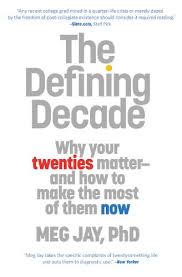
Your Twenties Do Matter

Meg Jay, PhD THE DEFINING DECADE—Why your twenties matter--and how to make the most of them now.
Our twenties only happens to us once, and what we do during that time matters more than most of us thought. That is the premise of clinical psychologist Dr. Meg Jay's book The Defining Decade , Why your twenties matter--and how to make the most of them now. These years are much more important than the current "hype" we hear in magazines, social media, and in popular conversations.

Dr. Jay helps the reader understand these years are a "defining decade" (pg. xv) and what we do with them determines our pathway into later adulthood. Dr. Jay encourages those in their twenties to use  this time wisely and with purpose to propel oneself into where and who we want to be. In each of her sections, "Work," "Love," and "the Brain and the Body", the reader learns more about why "thirty is not the new twenty" (pg. xxvii). Using current research on the adult brain learning theories she supports the thinking that during our twenties we have optimal opportunities to create the pathway to a purposeful and meaningful life.

Although I am well past this period in my own life I have adult children in this stage of optimal personal and professional development. How to share this information becomes a delicate dance. Pushing too hard into this conversation they pull away and look to other resources to validate their reasoning. Waiting for the right opportunity becomes the better solution. Dr. Jay refers to Carol Dweck's, growth mindset way of thinking. "For those who have a growth mindset failures may sting but they are also are viewed as opportunities for improvement and change" (pg. 158). Building your "identify capital" at home and in the work force (pg. 3), by developing new connections with "weak ties" (pg. 17) can make the unthought known" (pg. 33) to build a "customize life" (pg. 54) so your life actually is better than what you find on Facebook (pg. 41).

Here is a summary in Dr. Jay's own words on TedTalk:  http://www.ted.com/talks/meg_jay_why_30_is_not_the_new_20?language=en